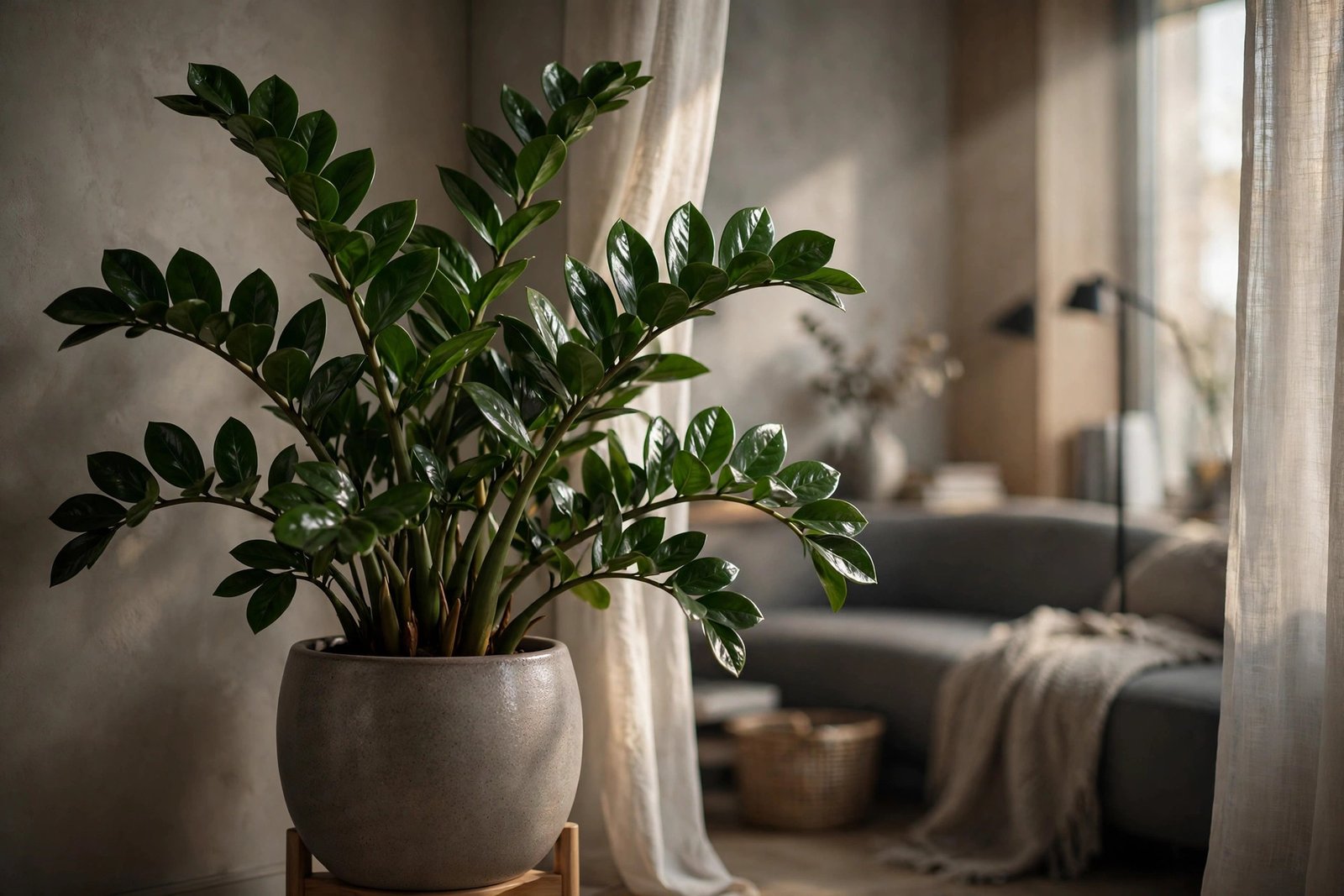
What if I told you the best houseplant for a busy person is one you can completely ignore for a month — and it will look better for it? That’s the ZZ plant in one sentence. I bought my first one in 2020 from the clearance rack of a supermarket, mostly because it was the only green thing in the flat I hadn’t killed yet. Five years later it has survived two house moves, a winter of my flat dropping to 14°C, and at least three separate months where I forgot it existed. It has never once made me feel guilty, which is more than I can say for my peace lily.
ZZ plant care has a reputation for being easy, and for once the reputation is accurate. This is Zamioculcas zamiifolia, a plant from the dry grasslands of eastern Africa — Zanzibar, Kenya, South Africa — that stores water in fat underground rhizomes and wears leaves so waxy they look polished. It treats neglect as a care strategy. That said, people do kill ZZs, and they almost always kill them with kindness: too much water, too big a pot, too much fussing. Here’s everything I’ve learned about keeping one genuinely thriving, not just surviving.
Quick Tips:
- Water every 2–3 weeks in spring and summer, once a month or less in winter — only when the soil is fully dry.
- Bright indirect light is ideal; it tolerates low light but grows far slower there.
- Use a free-draining mix: cactus/succulent compost with extra perlite works best.
- Never let it sit in water — soggy soil rots the rhizomes, and that’s the main killer.
- Wipe the leaves with a damp cloth now and then; dust dulls that famous shine.
What Makes the ZZ Plant Nearly Indestructible
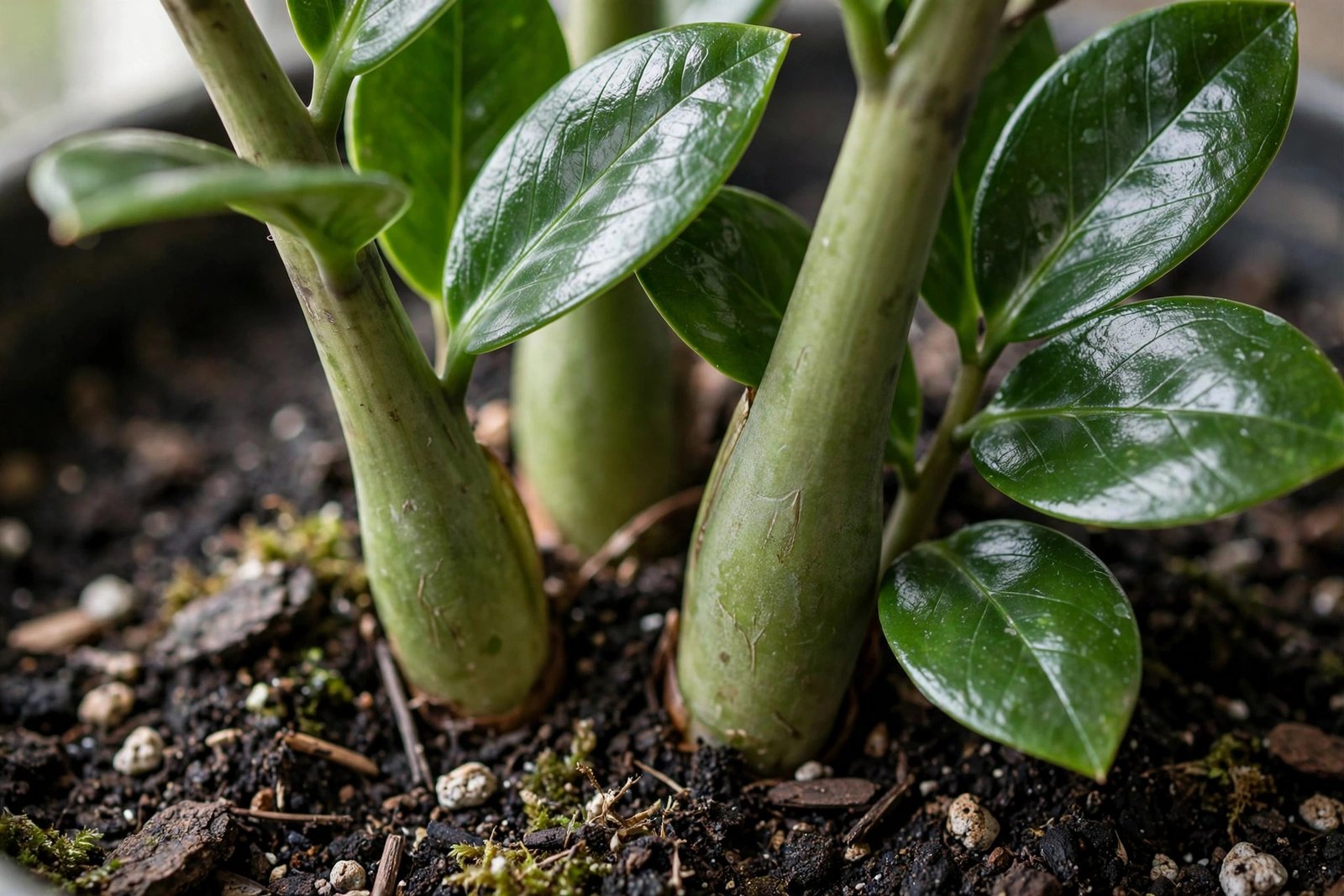
To look after a ZZ well, it helps to know what it actually is: a survival machine. Underground it grows thick, potato-like rhizomes — swollen stems that hold water like a camel’s hump. Above ground, the arching stems carry pairs of oval leaflets coated in a waxy cuticle that slows water loss. The whole plant is built for months of drought punctuated by downpours, which is why it’s perfectly happy with your “I water when I remember” routine.
My first one sat on top of a bookshelf for most of its first year, in a corner that got maybe an hour of morning sun. It grew slowly — ZZs are not fast plants — but it stayed green, upright, and glossy. When I eventually repotted it, the rhizomes had nearly doubled. It had been quietly getting on with things the whole time.
Light: What “Low Light Tolerant” Really Means
ZZ plants get sold as low-light plants, and it’s true they tolerate dim corners — mine has lived in them. But “tolerate” and “thrive” are different things. In a bright spot with indirect light for most of the day, my newer ZZ puts out three or four new stems every spring and summer. The bookshelf one put out one stem a year.
Here’s how I think about it:
- Best: bright, indirect light — a metre or two from an east or west window, or behind a sheer curtain on a south-facing one. About six hours of good daylight keeps it actively growing.
- Fine: a north-facing window, or a few feet back from brighter windows. Growth slows, but the plant stays healthy.
- Survives: dim corners, hallways, offices with fluorescent lighting. I’ve seen ZZs live for years under office fluorescents alone. Just don’t expect new growth.
One thing to avoid: harsh, direct midday sun through glass. Those waxy leaves can scorch, leaving pale bleached patches that never recover. If you want ideas for other tough plants for dim spots, my guide to low-light houseplants that survive anything is the natural next read.
Watering: The One Way People Kill ZZs
If there’s a single sentence to take from this whole guide, it’s this: underwatering a ZZ is almost impossible; overwatering it is easy. Every dead ZZ I’ve ever seen died of wet feet. The rhizomes sit in soggy compost, rot sets in, and one day a stem pulls away from the base with a sickening softness. It happens fast and it’s heartbreaking.
My routine, in a 7-inch (18 cm) pot in an average flat:
- Spring and summer: every 2–3 weeks. I push a finger into the soil; if it’s dry all the way down, I water deeply until it drains out the bottom. If there’s any dampness, I walk away.
- Autumn and winter: once every 4–6 weeks. The plant barely drinks when light levels drop. I once went two months in January without watering and it didn’t blink.
A few habits that keep you out of trouble: always use a pot with drainage holes, and empty the saucer after watering. If you keep plants in decorative cache pots without holes, take the inner pot out to water it, let it drain, then put it back. And when in doubt, wait another week — a ZZ would always rather be dry than wet. The guide to overwatering versus underwatering walks through the warning signs if you’re not sure which problem you’re looking at.
Soil and Potting
ZZs want what their rhizomes evolved for: soil that drains fast and doesn’t stay soggy. Ordinary houseplant compost on its own holds a bit too much water for my liking, so I mix roughly two parts cactus or succulent compost with one part perlite or coarse grit. You want water to run through freely — if you water and the surface still looks puddled after a minute, the mix is too heavy.
Pot size matters more than most people think. A ZZ in a pot that’s too big sits in a reservoir of wet compost it can’t drink fast enough. Go up only one size when repotting — from a 6-inch pot to a 7 or 8-inch one, say — and only every two to three years, in spring. ZZs are genuinely happy slightly pot-bound; my oldest one went four years in the same pot and grew its best stems in year three.
How I Repot Mine
I do this on a potting mat on the kitchen floor, because soil gets everywhere. Tip the plant out and check the rhizomes — they should be firm and pale, like small potatoes. Cut off anything mushy with a clean knife, settle the plant back at the same depth (burying rhizomes deeper invites rot), fill in with your gritty mix, and wait a few days before watering.

Feeding: Less Is More
ZZs are not hungry plants. In the growing season — roughly April to September — I feed mine about once every six to eight weeks with a half-strength balanced liquid houseplant feed. That’s three or four feeds a year, total. In winter, nothing at all.
More fertiliser won’t make it grow faster — I tried monthly feeds at full strength in 2021 and all I got was pale, floppy new growth. If you see a white crust on the soil surface, flush the pot with plain water and skip the next feed.
Temperature and Humidity
ZZs are comfortable in the same temperatures you are: roughly 60–75°F (15–24°C) suits them perfectly. They’ll tolerate a warm flat in summer and a cooler one in winter, but keep them away from two things: cold draughts from windows left ajar in January, and the blast of hot air from a radiator. Both show up as yellowing stems within a week or two.
Humidity is gloriously unfussy. Average indoor air is fine; they don’t need misting, pebble trays, or a humidifier. That waxy coating on the leaves does the work that other plants need humidity for.
Propagation: Slow but Deeply Satisfying
Propagating a ZZ is a lesson in patience. You can do it three ways:
- Division (fastest): when you repot a large plant, gently pull the rhizome clump apart so each section has at least one stem and some roots, and pot them up separately. New growth usually appears within a couple of months.
- Stem cuttings: cut a whole stem, let the cut end dry for a day, then stand it in water or push it into moist perlite. Roots form in 6–8 weeks; the first rhizome and new stem can take six months or more.
- Leaf cuttings (slowest): single leaflets pushed into moist compost will form tiny rhizomes — eventually. I’m talking 6–9 months before you see a shoot. It works, and it’s genuinely thrilling when it does, but it’s a project, not a plan.
The water-propagation method in my guide to propagating houseplants in water works for ZZs too — just expect everything to take about twice as long as the guide suggests.
Troubleshooting the Usual Problems
Yellow stems and leaves
Almost always too much water. Let the soil dry out completely, then resume watering far less often. If the base is mushy, unpot, cut away the rotted rhizome, and repot the healthy sections into dry mix.
Brown, crispy leaf tips
Usually a brief dry spell the plant would otherwise have survived. Trim the brown bits with clean scissors and adjust your watering rhythm.
Stems leaning or flopping
Long, stretched stems that lean usually mean the plant is reaching for more light. Move it closer to a window gradually, and rotate the pot a quarter-turn every month so growth stays even. Very occasionally it means you’ve overfed and the new growth is soft.
Pests
ZZs are rarely troubled, but check for mealybugs (white cottony blobs in leaf joints) and scale (small brown bumps on stems). Dab them off with a cotton bud dipped in rubbing alcohol and keep an eye out for a fortnight. Good air circulation and not overwatering prevent most of it.
Quick Answers to Common Questions
How fast does a ZZ plant grow?
Slowly — that’s normal, not a problem. In good light, expect a few new stems per year, each unfurling over several weeks. A ZZ that puts out three or four new stems in a growing season is doing brilliantly. If yours has done nothing for a year, it’s probably in very low light; move it closer to a window and be patient.
Is the ZZ plant toxic to pets?
Yes — all parts contain calcium oxalate crystals, which can irritate mouths and stomachs if chewed or eaten. It’s not usually dangerous in the way some houseplants are, but I keep mine on a high shelf away from my sister’s cat when she visits. If you have a determined plant-chewer, a ZZ is better placed out of reach.
Why are my ZZ stems flopping over?
New stems naturally arch as they mature, which is part of the plant’s fountain-like shape. But stems that go suddenly floppy and soft at the base are a rot warning — check the rhizomes and cut back watering immediately. Stems that grow very long and lean in one direction are reaching for light.
How do I keep the leaves so glossy?
The shine is natural — that waxy coating is built in. Dust dulls it, so wipe the leaflets with a damp cloth every month or two. Skip leaf-shine sprays; they can clog the leaf surface over time. A clean, healthy ZZ is glossy all on its own.
Can a ZZ plant live in a bathroom with no window?
For a while, yes, but not happily forever. ZZs tolerate low light remarkably well, but a truly windowless room will eventually exhaust them. If you want bathroom greenery, rotate two plants: one in the bathroom for a few weeks while the other recovers in better light.
So that’s zz plant care, the whole of it: decent light, a free-draining pot, and water only when the soil is properly dry. Mine has forgiven every mistake except one — the winter I watered it weekly “just in case” and rotted half its rhizomes. It recovered, because that’s what ZZs do. Yours will too.