The winter my apartment turned into a fly zone, I had about fourteen houseplants and absolutely no idea what I was doing. It was my third year of growing things, the days were short and grey, and I watered everything every Sunday out of guilt — a good soak for each pot, whether it needed it or not. One evening a tiny black speck drifted past my face while I made tea. Then another. I leaned over my monstera and saw them: dozens of miniature flies hovering low over the soil, rising and settling like dust that refused to land.
I’d filed “fungus gnats” under greenhouse problems, not apartment problems. That winter taught me the single most useful thing about how to get rid of fungus gnats for good: you are never fighting the flies you can see. You’re fighting the nursery you can’t — the eggs and larvae in the top few centimetres of your potting soil. Kill the adults and feel victorious; the next generation is already underground, on a schedule.
What Fungus Gnats Actually Are (And Why They Picked You)
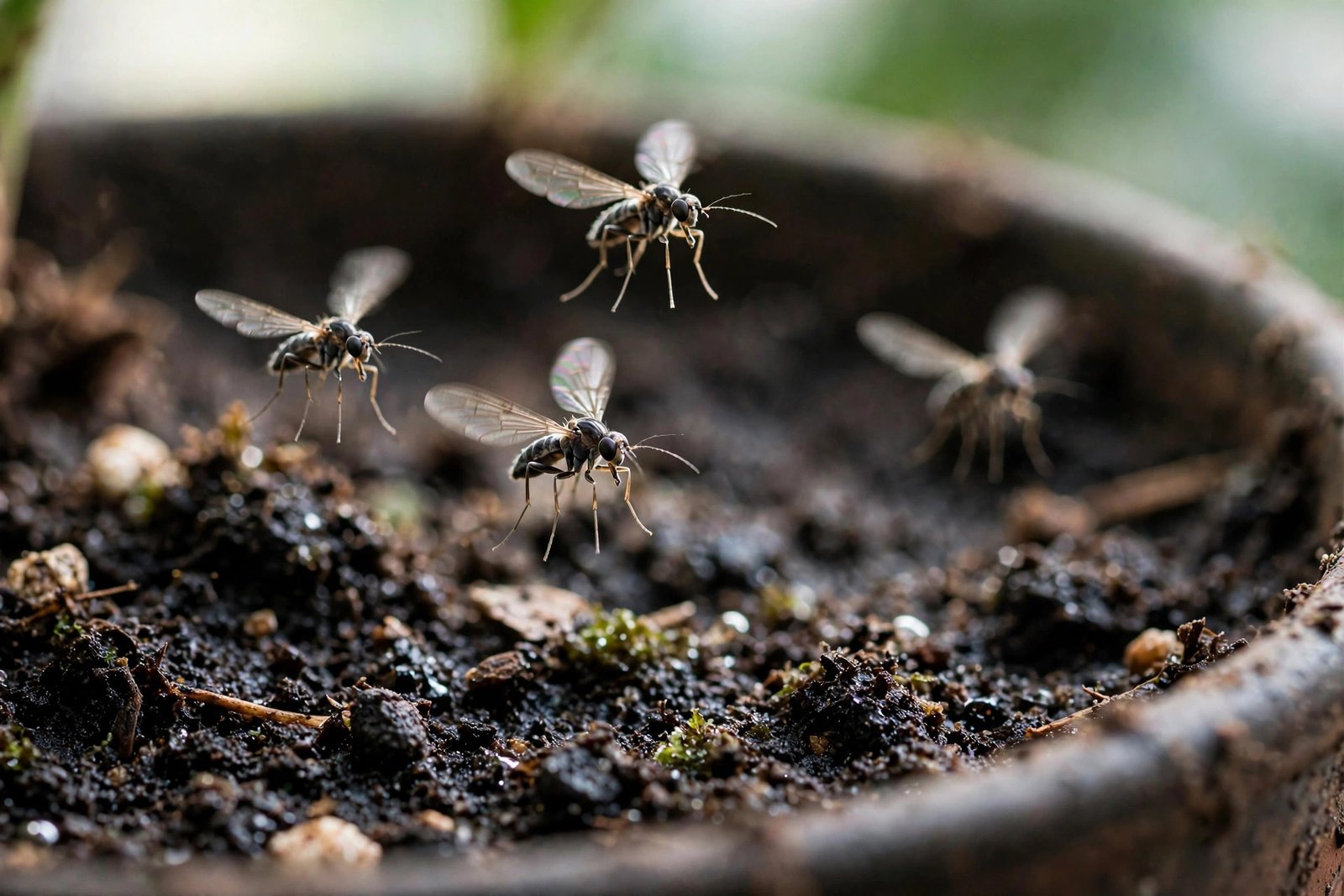
Fungus gnats are tiny — about 2–3 mm, smaller than a fruit fly — dark-bodied, with a habit of hovering just above the soil rather than landing on your fruit bowl. That last detail is the giveaway: fruit flies circle your kitchen; fungus gnats circle your pots. The adults themselves are harmless. They don’t bite, they don’t spread disease to people, and they don’t chew leaves. They’re just annoying in the specific way of a tiny insect near your face while you’re trying to relax.
The trouble is what they leave behind. A single female can lay up to 200 eggs in the moist top layer of potting soil, among the decaying organic matter and fungi that give these insects their name. Eggs hatch in four to six days; the larvae — tiny translucent worms with black heads — feed for roughly two weeks, then pupate for about a week before emerging as the next cloud of adults. The whole cycle takes three to four weeks, and in a warm apartment it runs year-round.
The larvae mostly eat fungi and decaying matter, so established plants usually tolerate a mild infestation. But they also nibble fine root hairs, and that’s where the real damage happens: seedlings and young plants can stall, yellow, and collapse under a heavy larval load. My winter casualties were a tray of windowsill basil seedlings — they keeled over one by one, and I blamed damping-off until I spotted the larvae wriggling in the soil.
Step 1: Dry Out the Top Layer (This Is Most of the Job)
The uncomfortable truth behind my gnat winter: I caused it. My guilty Sunday soakings kept the top layer permanently damp — exactly what gnats need to breed. The most powerful fix — more powerful than any trap or product — is letting the top 2 inches (about 5 cm) of soil dry out between waterings. Eggs and young larvae desiccate in dry soil: no moisture, no nursery.
For most houseplants this is completely safe — monsteras, pothos, snake plants, ZZ plants all prefer drying out to sitting soggy, especially in winter when they drink far less. Push your finger in to the second knuckle: cool and damp means walk away; dry means water deeply. That replaced my Sunday schedule permanently.
If you’re still calibrating your instincts, the guide to overwatering versus underwatering walks through how to read the signs, and how often to water indoor plants covers the routine I use now. The pattern you’ll notice: nearly every gnat story starts with too much love from the watering can.
Bottom watering helps enormously too: set the pot in a few inches of water for 20–30 minutes and let the soil drink from below. The surface stays dry while the roots get what they need — the opposite of what gnats want. I bottom-water my peace lily and ferns, since those two prefer steadier moisture.
Step 2: Trap the Adults With Yellow Sticky Traps
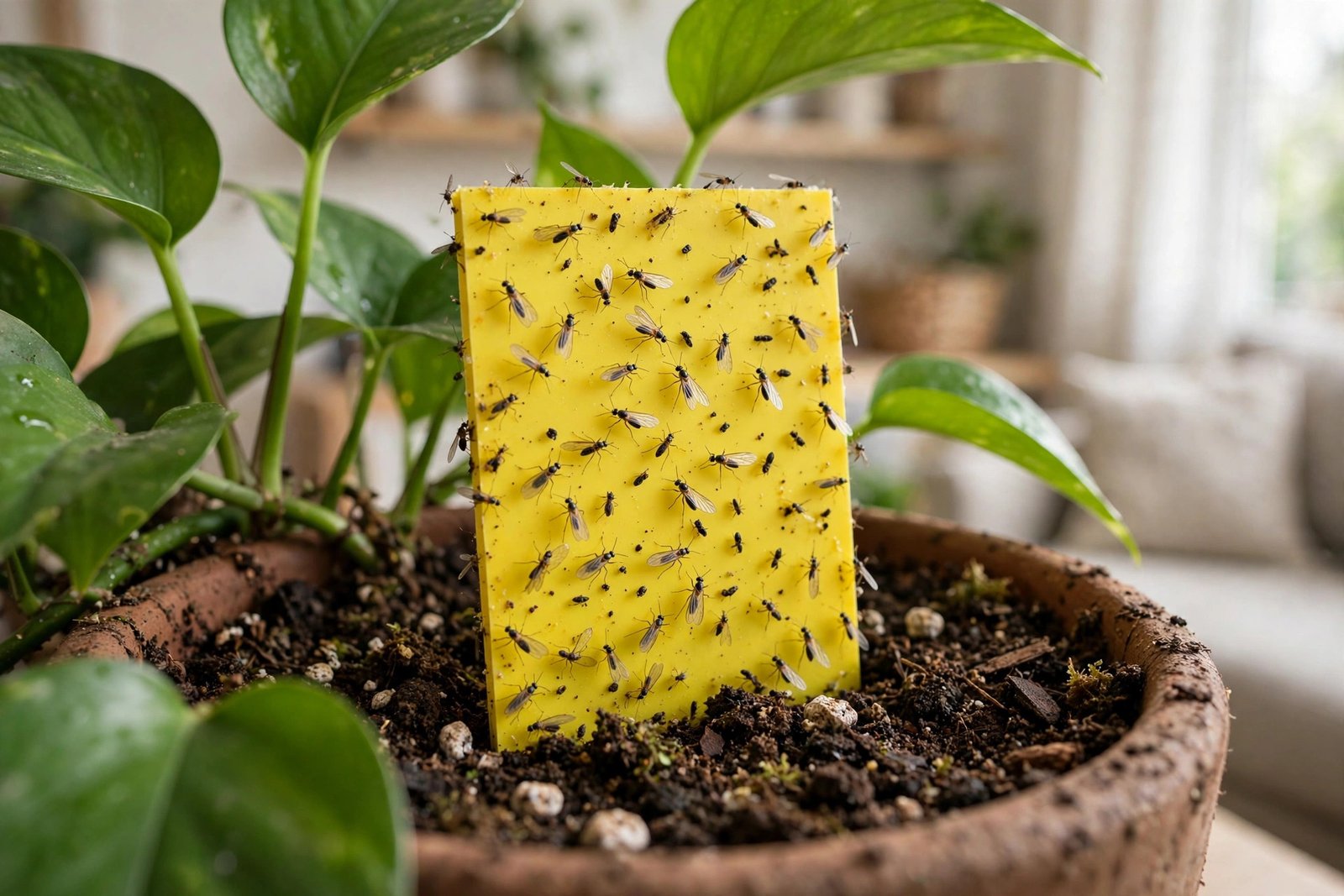
Yellow sticky traps — little yellow cards on sticks poked into the soil — won’t end an infestation alone, and I want to be honest about that: the adults you catch are replaced by larvae already underground. What traps do brilliantly is break the egg-laying side of the cycle — every female stuck to a card is a few hundred eggs never laid.
Put one trap per affected pot near the soil surface (two for a big 10-inch pot), and replace them weekly — a card black with gnats stops catching. They double as your progress report: when the weekly catch shrinks from dozens to a handful to none, the breeding cycle is collapsing.
Step 3: Cap the Soil With Sand or Fine Gravel
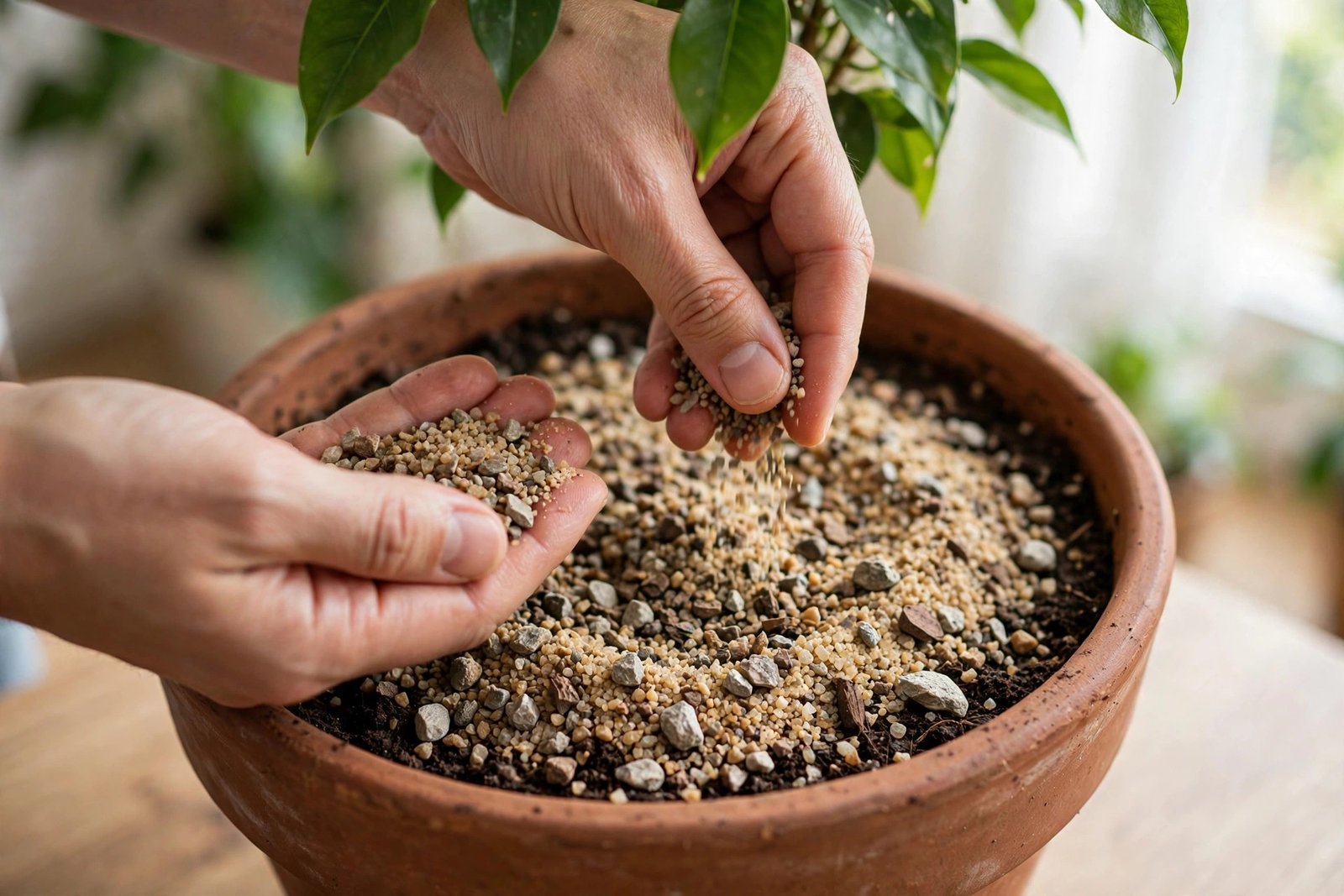
Female gnats lay eggs in moist organic matter, so a dry mineral cap makes pots far less inviting. Spread 1–2 cm (about half an inch) of coarse sand, fine gravel, or horticultural grit over the soil. It dries within hours while the soil below stays moist — water passes straight through, so your routine doesn’t change.
I did all fourteen pots one Saturday afternoon in about twenty minutes. Keep the layer clear of the stems, top it up every few months as it works down into the soil — and note the gravel version actually looks quite smart in terracotta.
Step 4: Treat the Larvae in the Soil
Drying, trapping, and capping handle adults and eggs. But with a heavy infestation — the kind where the soil seems to shimmer when you water — you want something that goes after the larvae directly. That something is Bacillus thuringiensis israelensis, mercifully shortened to BTI, sold as “mosquito bits” in most garden centres.
BTI is a naturally occurring bacterium toxic to fly larvae — mosquitoes and fungus gnats included — while leaving plants, people, and pets alone. Soak a spoonful of the granules in your watering can for half an hour, strain out the bits, and water your plants with the resulting tea; the larvae ingest it with their next meal and stop feeding. I was sceptical — it sounds like one of those internet remedies — but it’s the one biological control indoor growers consistently swear by, and it visibly thinned my infestation within two waterings.
Repeat for two or three waterings, following the packet instructions — watering normally, deeply but only when the top layer is dry, just with the BTI tea instead of plain water.
Quick Tips:
- Let the top 2 inches (5 cm) of soil dry out between waterings — this alone breaks the breeding cycle.
- Put one yellow sticky trap in each affected pot and replace it weekly until the catch drops to zero.
- Cap the soil with 1–2 cm of coarse sand or fine gravel to make egg-laying harder.
- Water with BTI (mosquito bits) tea for two or three waterings to kill larvae in the soil.
- Keep every step going for a full month after the last gnat you see — the cycle outlasts your patience.
Step 5: Refresh the Top Soil and Quarantine Newcomers
Eggs and young larvae live almost entirely in the top 5 cm of soil, so scoop off the top inch of compost from each affected pot and replace it with fresh, dry mix — you’re physically removing a huge chunk of the next generation. I did this on my five worst pots and adult numbers dropped within days.
Empty every saucer too: standing water keeps the bottom of the soil damp and breeds gnats just as happily as a wet surface. And quarantine every new plant for two weeks before it joins the collection — an astonishing number of infestations arrive home in the nursery pot, whose soil is kept moist. Hallway first; living room only once I’m sure it brought no guests.
What Doesn’t Actually Work (I Tried)
Here’s what I wasted time on that winter:
- Apple cider vinegar traps. The classic dish of vinegar with a drop of soap catches some gnats, but it’s designed for fruit flies, which are drawn to fermentation. Fungus gnats are drawn to damp soil — you’ll catch a few wanderers and miss the actual problem.
- Cinnamon on the soil. It smells festive and supposedly has antifungal properties. The gnats, in my experience, did not care even slightly.
- Spraying the leaves. Insecticidal soap and neem oil have their place — the guide to natural remedies for common houseplant pests covers where they genuinely help — but gnat adults live about a week regardless, and the larvae are underground. Spraying foliage fights the wrong battle.
- Letting a moisture-loving plant dry out completely. You’ll kill the fern before you kill the gnats. Match the weapon to the plant: drying for the tolerant ones, BTI and sand caps for the thirsty ones.
How Long Until They’re Gone?
The life cycle sets the timeline: adults live about a week, larvae feed for two, pupae sit for one. Even with a perfect routine, expect three to four weeks before the last of the existing larvae emerge and the whole thing winds down — mine took five weeks from the Saturday I got serious to the first genuinely gnat-free morning.
The classic mistake — mine included, the first time — is stopping too early. Two quiet weeks is not victory; it’s the gap between generations. Keep the traps up, keep the top layer dry, and keep the sand caps on for a full month after the last gnat you see. The cycle outlasts your patience, so plan for it.
Frequently Asked Questions
Do fungus gnats bite people or pets?
No. They’re one of the few indoor pests that are purely a nuisance — no biting, no stinging, nothing spread to people or animals. The worst they do is hover near your face while you’re trying to relax. Your cat may find them entertaining, which is the only upside I’ve found.
Will fungus gnats kill my houseplants?
Established plants with healthy roots almost always survive; they might sulk a little, but they recover once the gnats are gone. The real victims are seedlings and very young plants, whose fine roots can be seriously damaged by heavy larval feeding. Starting seeds indoors? Keep that soil on the dry side and add a sand cap from day one.
Can I just repot everything in fresh soil and be done with it?
A full repot helps but rarely ends it alone — eggs and tiny larvae cling to the root ball and come along for the ride, and you’ll stress every plant in the process. The top-inch soil swap plus BTI waterings is less traumatic and just as effective. Save the full repot for plants that genuinely need a bigger pot anyway.
Why do they keep coming back every few months?
Almost always, the watering discipline slipped. A busy fortnight, or a well-meaning houseguest with a watering can, keeps the top layer damp long enough for a new generation — and one female is all it takes to restart the cycle. When I see the first gnat of a relapse, I check my watering habits before reaching for anything else.
Are yellow sticky traps safe to use around cats and curious toddlers?
The traps themselves are just sticky yellow plastic — no chemicals — but they are extremely sticky, and a cat brushing past one will not enjoy the experience. I trim mine small, push them deep into the pot so only the top shows, and keep treated pots on high shelves during treatment. A minor logistics puzzle, not a safety problem.
That gnat winter feels like a lifetime ago now. My collection has roughly doubled since — the balcony in summer, the windowsills in winter — and I haven’t had a real infestation since, just the odd stray that meets a sticky trap and a drier regime. Get the soil right and the flies simply have nowhere to begin.