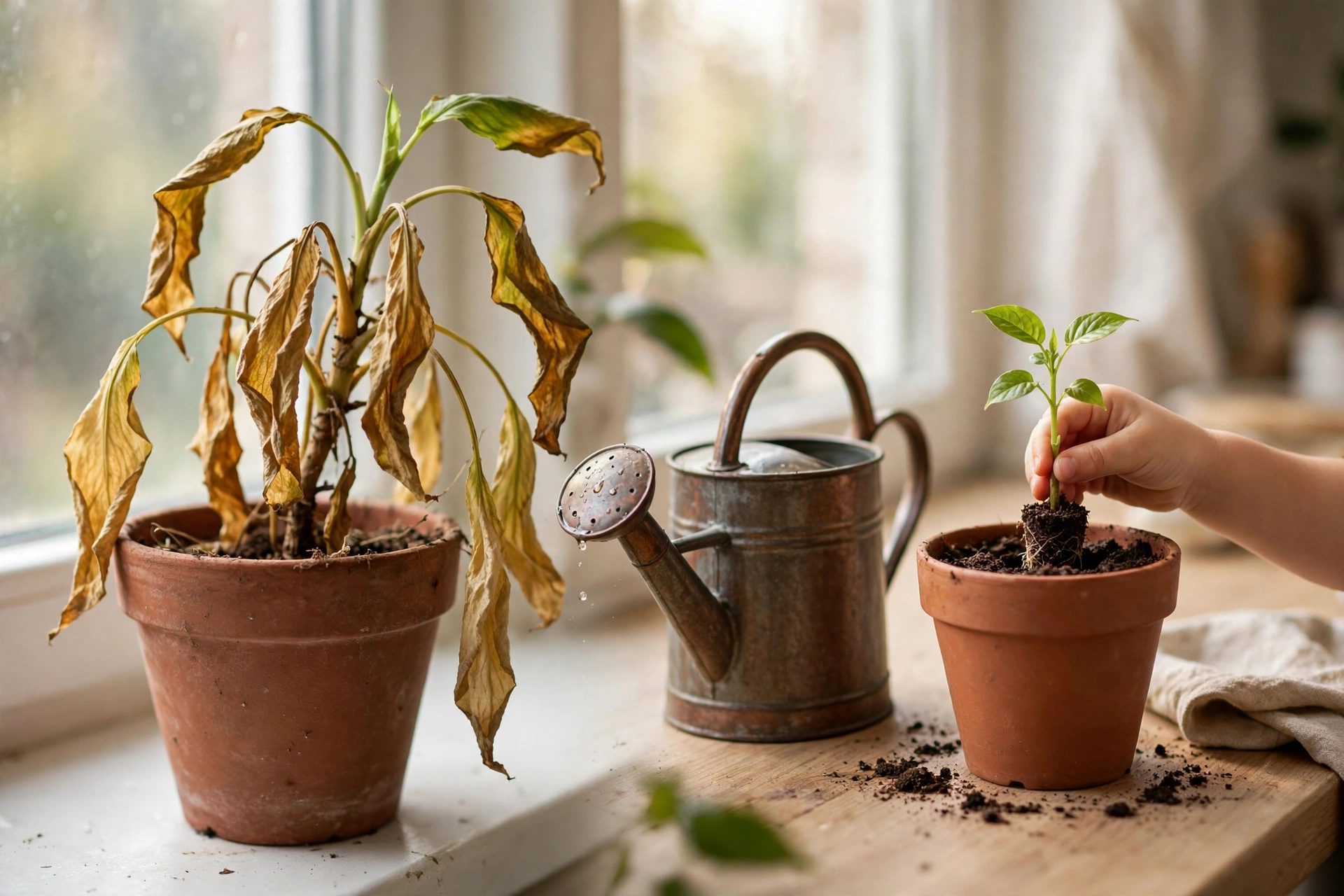
There’s a special kind of guilt that comes with a dying plant. It’s sitting there, brown and limp, and you keep watering it because doing nothing feels worse — even though you suspect you’re the one who did this. If you’re reading this because you want to know how to revive a dying plant, I’ve stood exactly where you’re standing now.
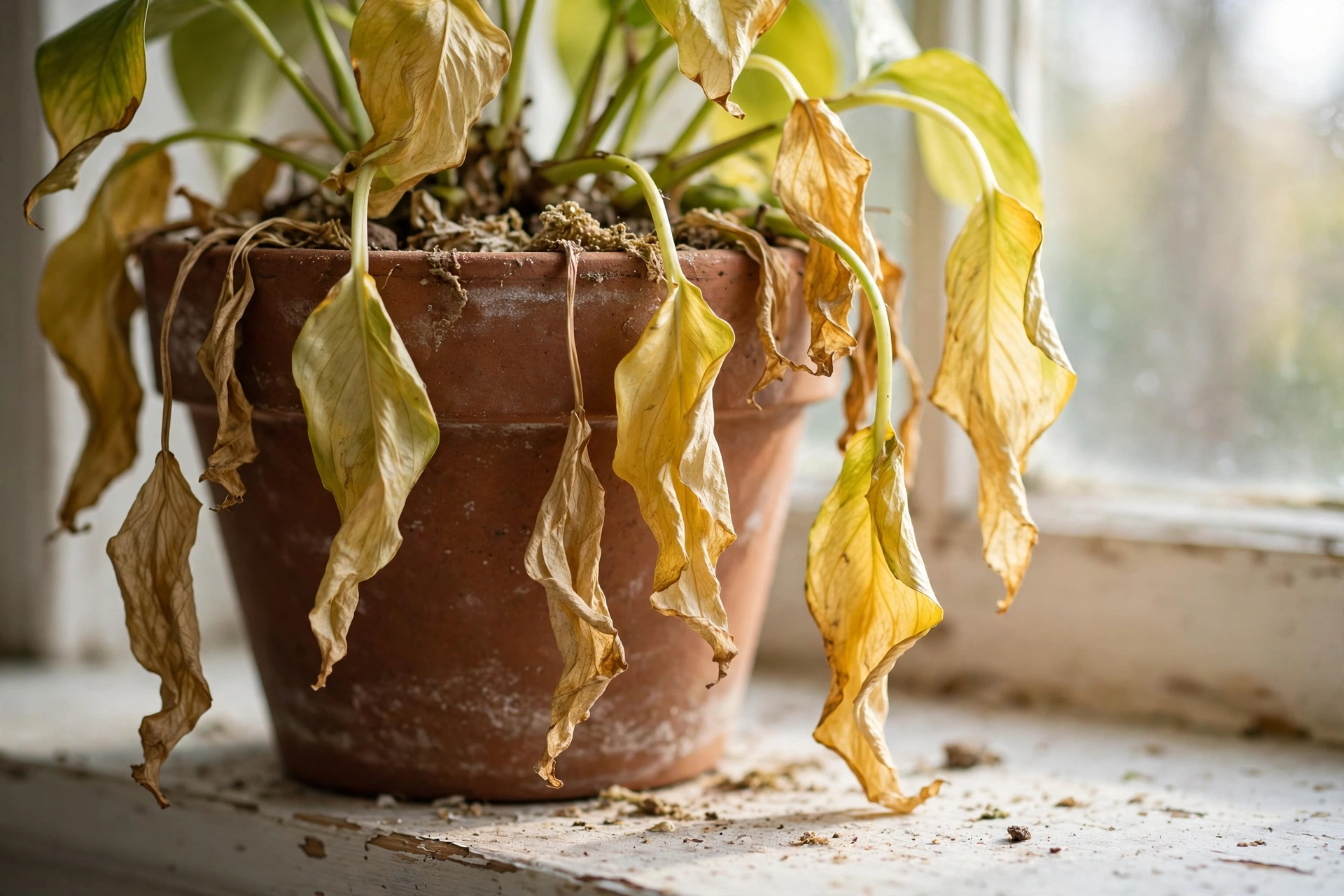
Two winters ago, I found my golden pothos — four years old, survivor of three apartments — completely collapsed. Every leaf hung down like a wet tissue. My first thought: I killed it. But here’s what I’d love to tell you: most houseplants are far tougher than they look, and a surprising number of “dead” plants are just having a very bad month. That pothos? It’s still alive today, looking smug from the bookshelf.
How to Revive a Dying Plant, Step 1: The Scratch Test (Is It Even Alive?)
First, one honest answer: is there still life in there? A plant can lose every leaf and still be alive at the roots — or look okay and be past saving. Here’s how to tell.
The scratch test. Pick a stem near the base. With your fingernail or a clean knife, gently scratch a thin sliver of the outer bark. Look underneath:
- Green and moist? The stem is alive. There’s real hope.
- Brown, tan, or dry and brittle? That stem is dead — but check lower down. Plants often die back from the tips while the base hangs on.
- Brown all the way to the soil? Check the roots and the very base at soil level. A hint of green anywhere means it’s not over.
Other signs of life: tiny new buds, stems that feel firm rather than mushy, and roots that are white or tan instead of black and slimy. Any one of those means you’ve got a patient, not a corpse.
This test has saved me from composting at least two plants that looked finished. My neighbour’s fiddle-leaf fig lost every leaf in February — just a bare stick. The scratch test showed green at the base; in late April a tiny leaf appeared — the most exciting leaf I’ve ever seen.
Step 2: Diagnose the Cause — The Five Usual Suspects
Figuring out how to revive a dying plant starts with knowing what hurt it — most cases come down to one of these five. Run through them like a detective.
1. Overwatering (the number-one killer)
The cause beginners least suspect, because watering feels like caring. Signs: yellow leaves that fall at a touch, constantly damp soil, mushy stems, a sour smell. The cruel twist: an overwatered plant droops, which looks like thirst, so people water it more. If yours is drooping in wet soil, put the watering can down — and read the guide to telling overwatering apart from underwatering, because getting this wrong is how rescues fail.
2. Underwatering (the easiest fix)
Crispy brown leaf edges, soil pulled away from the pot sides, a pot that feels suspiciously light. The most forgiving problem on the list — a thirsty plant that perks up within a day of deep watering was simply asking for a drink.
3. Wrong light
Too little light gives pale, leggy growth reaching toward the window, with lower leaves dropping. Too much direct sun gives scorched patches on the leaves facing the glass. My pothos spent a whole winter in a dark corner, slowly starving for light while I blamed myself for “forgetting” it.
4. Root-bound (pot too small)
This was the other half of my pothos story. When I slid it out of its pot, the roots were a solid white brick — a tight circling knot with no soil visible, and water ran straight through. If your plant dries out insanely fast, hasn’t grown in months, or has roots poking from the drainage holes, it’s pot-bound — no amount of careful watering fixes that.
5. Pests
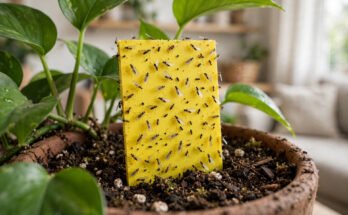
Look for sticky residue, fine webbing (spider mites), cottony white blobs (mealybugs), or small flies around the soil. Pests rarely kill a healthy plant, but they’ll finish off a stressed one — these natural remedies for common houseplant pests sort it out without harsh chemicals.
Step 3: The Rescue Sequence
This is the core of how to revive a dying plant: six steps in order — each sets up the next, and skipping ahead is how well-meaning rescues go sideways.
1. Trim away the dead parts. Dead leaves and stems are dead weight — remove them so the plant’s energy goes to living tissue. With clean scissors (wipe the blades with rubbing alcohol), snip off anything brown, crispy, or mushy, cutting back to green tissue. It’ll look worse before it looks better — my pothos was three sad stems at this stage. That’s normal. Just don’t remove more than a third of the healthy growth.
2. Fix the watering — once, properly. Water slowly until it runs freely out of the drainage holes, wait ten minutes, water once more. Then leave it alone. The rule from here on: check the soil with your finger before every watering. Top inch or two dry? Water. Damp? Walk away. An overwatered plant might need no water for a week or two — drying out is the treatment.
3. Check the roots. Tip the plant out of its pot and look. Healthy roots are white or tan and firm; rotted ones are dark, mushy, and smell bad — trim back to firm, pale tissue. If the roots are a solid circling mass, gently tease the bottom apart so they can grow outward.
4. Repot if it needs it. Repot when the plant is root-bound, when you’ve trimmed rotted roots, or when the soil is old and compacted. Pick a pot only one or two inches wider — a huge pot stays soggy around a struggling root system. Fresh potting mix, drainage holes, same depth as before. Water it in, drain the saucer, and do not fertilise.
5. Give it the right light — gently. Move it to appropriate light, but don’t blast a stressed plant into full sun — sudden change is just another shock. Bright, indirect light is the recovery ward for most houseplants. My pothos went two feet from an east-facing window — morning sun, afternoon shade — and that’s where it turned the corner.
6. Now the hardest step: wait. You’ve done the work. Patience is honestly half of how to revive a dying plant — check the soil every few days and resist the urge to fiddle.
What NOT to Do (I’ve Made All of These Mistakes)
How to revive a dying plant is as much about restraint as action — the most common way to finish a stressed plant is loving it too hard:
Don’t fertilise a stressed plant. This is the big one. Fertiliser sounds like it would help, but a plant with damaged roots can’t take up nutrients, and fertiliser salts burn what’s left. Wait for a few weeks of new, healthy growth first. I once fertilised a struggling calathea “to give it strength,” and it was dead within a week. Learn from me.
Don’t repot into a much bigger pot. A huge pot of wet soil around a tiny root system stays soggy for weeks — and soggy is what got you here. One to two inches wider. That’s it.
Don’t move the plant around every day. Pick the right spot and leave it there — moving it daily is a fresh stress event every time.
Don’t overwater during recovery “just to be safe.” The finger test, every time. Recovery is when most rescues fail — people get anxious, the top looks dry, they water, and the plant drowns while healing.
Realistic Timelines: What Recovery Actually Looks Like
Here’s the honest answer to the question everyone asks when learning how to revive a dying plant: it depends on what was wrong — some signs are fast, some take a season. Knowing what to expect stops you panicking at week three.
- 24–72 hours: an underwatered plant should perk up dramatically after a deep watering. Still flat after three days? Something else is going on.
- 1–2 weeks: no new damage — no more yellowing or dropping. Stability comes before growth, and it’s the first sign you’re winning.
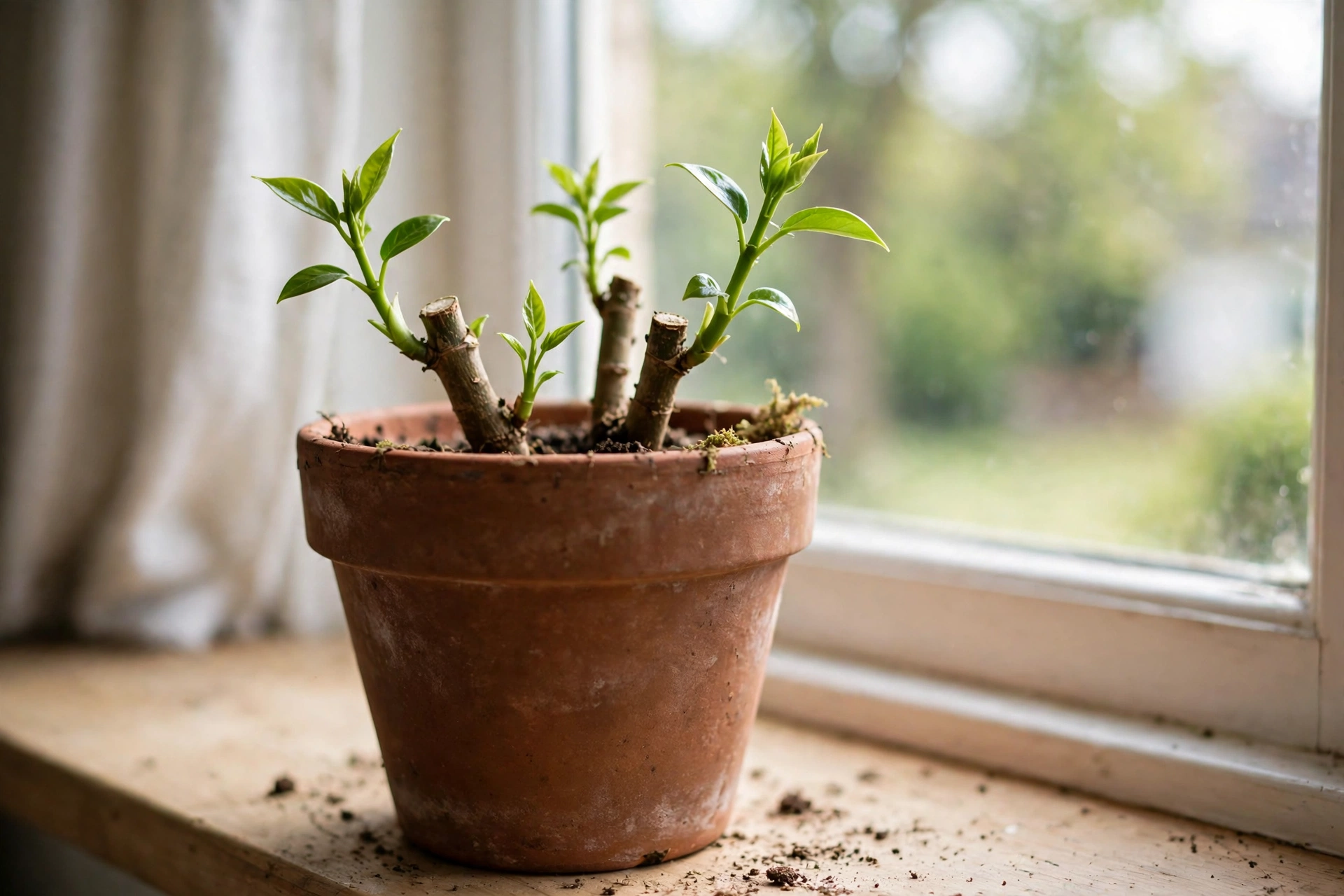
- 3–6 weeks: new growth appears — tiny leaves, fresh buds at the nodes. My pothos pushed out its first new leaf at five weeks, and I genuinely cheered.
- 2–3 months: the plant looks like itself again — fuller, bushier.
Two things to know. Yellow leaves never turn green again — trim them and judge recovery by new growth, not old. And winter recoveries are slower: a plant rescued in December might sit still for two months, then explode in March. That’s a plant waiting for spring, not a failure.
When to Let Go
Not every plant makes it — that’s not your fault, and it’s not failure. Let go when there’s no green under the bark anywhere, the roots are all black mush, stems snap like dry twigs, or the rot smell won’t improve. Knowing when to stop is part of how to revive a dying plant too — if you’ve given it four to six weeks of proper care with zero sign of life, it’s okay to stop.
The plant I couldn’t save was a maidenhair fern. I went away for two weeks in August, my neighbour forgot the key, and I came home to tumbleweed. I tried everything — nothing. Brown all the way down, the root ball crumbling like dust. A fern that crisp was never coming back, and the kindest thing was letting go instead of nursing it out of guilt.
Compost it if you can, and scrub the pot before reusing it — old soil can harbour the same problems. Let yourself feel a little sad. We get attached to these green things; that’s a feature, not a bug.
Frequently Asked Questions
Here are the questions I hear most about how to revive a dying plant — the short version of everything above.
Can a plant with no leaves come back?
Sometimes, yes. If the stems are alive (green scratch test) and the roots are healthy, many plants regrow from the crown or stem buds. My neighbour’s fiddle-leaf fig was a bare stick for two months before it sprouted. Give a leafless-but-alive plant six to eight weeks.
Should I cut off all the dead leaves?
Yes — dead leaves aren’t coming back, and removing them lets the plant spend energy on new growth. Use clean scissors, cut back to healthy tissue, and keep it to a third of the living plant at once. For the yellowing-but-not-dead ones, this guide to why houseplant leaves turn yellow and what each cause needs helps you decide what stays.
Can I revive a plant that’s been underwatered for weeks?
Often, yes — underwatering is the most forgiving problem there is. Soak the whole pot in a basin of water for 20–30 minutes (dry soil repels water poured on top), let it drain, and wait. If the stems are firm and there’s any green, most plants bounce back within days — one of the easiest wins in how to revive a dying plant.
Your Turn
Go look at your plant and do the scratch test. That one little scratch tells you whether you’ve got a rescue or a compost contribution — and if it’s a rescue, you now know how to revive a dying plant: trim, water, check the roots, repot if needed, light, wait. No fertiliser, no fussing, no panic-watering.
Most plants that look dead are asking for one thing to change — sometimes just a bigger pot and a brighter corner, which is all my pothos needed. It’s currently trying to take over the bookshelf. Your plant might surprise you. Give it the chance.