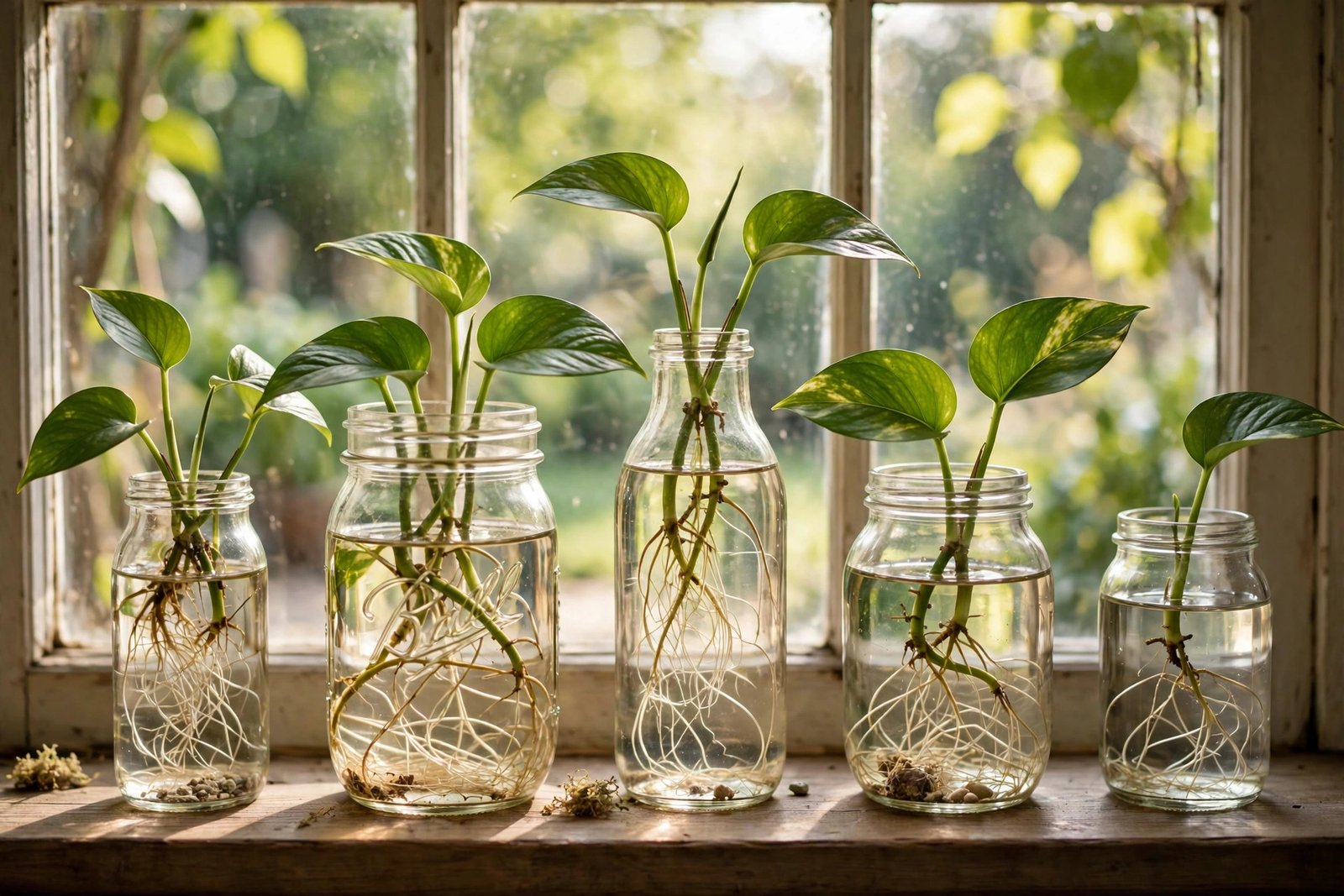
Picture a jam jar with a scraggly pothos cutting in it and the instruction: “just put it in water.” Skepticism is natural — then two weeks later the jar has a fistful of white roots. A month later it’s a whole new plant, and it cost exactly nothing. That jar is how many gardeners become people who see every healthy houseplant as a dozen future plants. Propagating houseplants in water is the easiest, most satisfying beginner skill in all of houseplant care — and this is everything worth knowing before a first mushy, rotted cutting.
Why Start Propagating Houseplants in Water?
Three reasons. First, it’s nearly foolproof for the right plants — no special equipment, no rooting hormones, no humidity domes. A jar, water, and a windowsill. Second, you can watch it happen. Roots are visible through the glass, which means you learn what healthy root growth looks like — knowledge that pays off everywhere else in plant care. Third, free plants. One pothos becomes five pothoses becomes gifts for everyone you’ve ever met. A windowsill full of rooting jars looks like a small science lab — and it’s worth it.
It also teaches you plant anatomy hands-on — after a few rounds, you’ll understand nodes and roots better than any diagram could teach you.
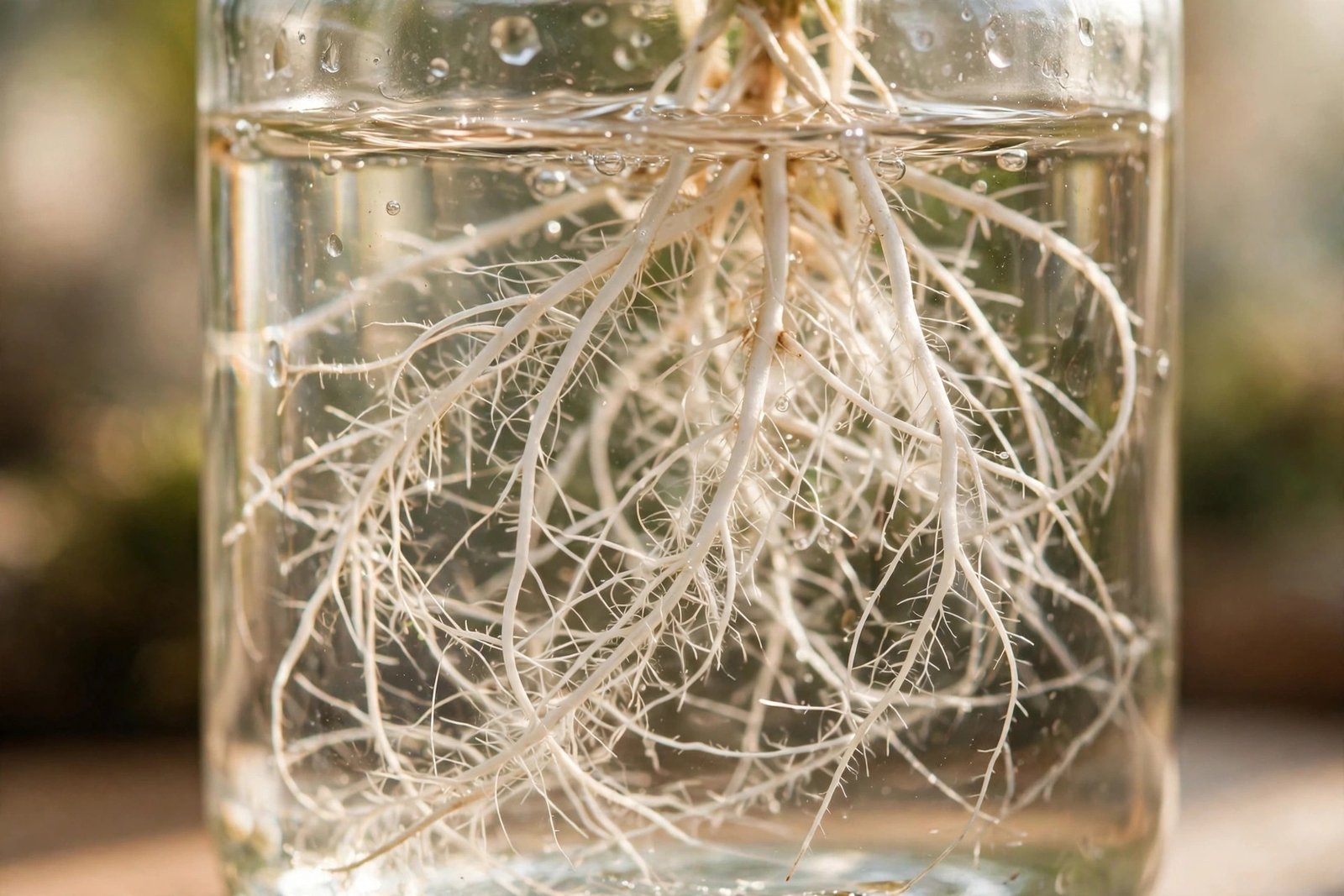
Plants that propagate easily in water
Not everything roots in water, and picking the right candidate is half the battle. These are the reliable ones — all forgiving, all fast enough to keep a beginner encouraged:
- Pothos (Epipremnum aureum) — the gold standard. Roots in 1–2 weeks, practically indestructible. If you only try one, try this.
- Heartleaf philodendron — just as easy as pothos, roots quickly from any node.
- Tradescantia (wandering plant) — roots absurdly fast, sometimes within days. Almost weedy in its enthusiasm.
- Spider plant babies — the dangling plantlets already have little root nubs; snip and drop in water.
- Arrowhead vine (Syngonium) — easy, quick, and the cuttings make great gifts.
- Coleus — roots in days and gives you a colorful plant for pennies.
- Mint and basil — snip a stem from your kitchen herbs, root it in water, plant it out. (More herb-growing in the guide to growing herbs on a windowsill.)
- Monstera deliciosa — slower (4–8 weeks), but it works, as long as your cutting includes a node.
Plants that don’t cooperate in water: most succulents and cacti (they rot before they root — propagate those in soil), snake plants (technically possible from leaf cuttings, but agonizingly slow and prone to rot), and ZZ plants (same story, measured in months). Stick with the easy list until you’ve got the rhythm down.
Finding the node (the one thing you must get right)
Every successful water propagation hinges on one small feature: the node. It’s the slightly swollen bump or ring on a stem where leaves and aerial roots emerge. Roots grow from nodes — not from smooth stem sections, not from leaf petioles. A cutting without a node is just a leaf in a jar; it’ll sit there looking hopeful and eventually give up.
On a pothos or philodendron, look along the vine for the little brown nubs opposite each leaf — those are aerial root beginnings marking the nodes. On tradescantia, the nodes are the slightly thicker joints where leaves attach. Take your cutting about a quarter inch (about 0.5 cm) below a node, using clean scissors or pruners. Wipe scissors with rubbing alcohol between plants — ten seconds, and it stops problems spreading.
Quick Tips:
- Always include at least one node on your cutting — no node, no roots.
- Strip off any leaves that would sit below the waterline; submerged leaves rot.
- Change the water every 5–7 days to keep oxygen levels up and prevent stagnation.
- Bright, indirect light speeds rooting; direct sun cooks the jar.
- Wait until roots are 2–3 inches (5–8 cm) long before moving to soil.
The method, step by step
Step 1: Take the cutting
Choose a healthy, pest-free stem with at least 2–3 leaves. Cut just below a node at a 45-degree angle — more surface area for rooting.
Step 2: Prep it
Remove the lower leaves so no foliage sits underwater — submerged leaves rot within days and foul the water, which can take the whole cutting down. You want at least one node below the waterline and leaves above it. If the cutting is long with multiple nodes, even better — more root sites.
Step 3: Jar it
Any clean glass jar works. Fill with room-temperature water — cold water shocks the cutting; hot water is obviously worse. Tap water that’s sat out overnight works well, though plain tap is fine for most plants. The node must be submerged; the leaves must not be. A narrow-necked bottle holds top-heavy cuttings upright nicely; for floppy ones, drape them over the rim or use a bit of plastic wrap with a hole poked in it as a support.
Step 4: Place it
Bright, indirect light — an east-facing windowsill is perfect. The cutting needs light energy to grow roots, but direct sun turns the jar into a little greenhouse and cooks everything. Room temperature around 65–75°F (18–24°C) is ideal; warmth speeds rooting noticeably.
Step 5: Maintain
Change the water every 5–7 days. This is the step everyone skips and the reason most cuttings fail — stagnant water loses oxygen and grows bacteria, and then the stem goes mushy. A weekly refresh takes thirty seconds. If the water ever looks cloudy or smells off, change it immediately and rinse the stem.
Step 6: Wait for roots
Pothos and tradescantia show roots in 1–3 weeks; monstera and heartleaf philodendron can take 3–6 weeks. Don’t transplant too early — wait until you have several roots at least 2–3 inches (5–8 cm) long, with some branching. A single half-inch root isn’t enough to support a plant in soil yet. Patience here is the difference between a cutting that thrives and one that collapses the week after potting.
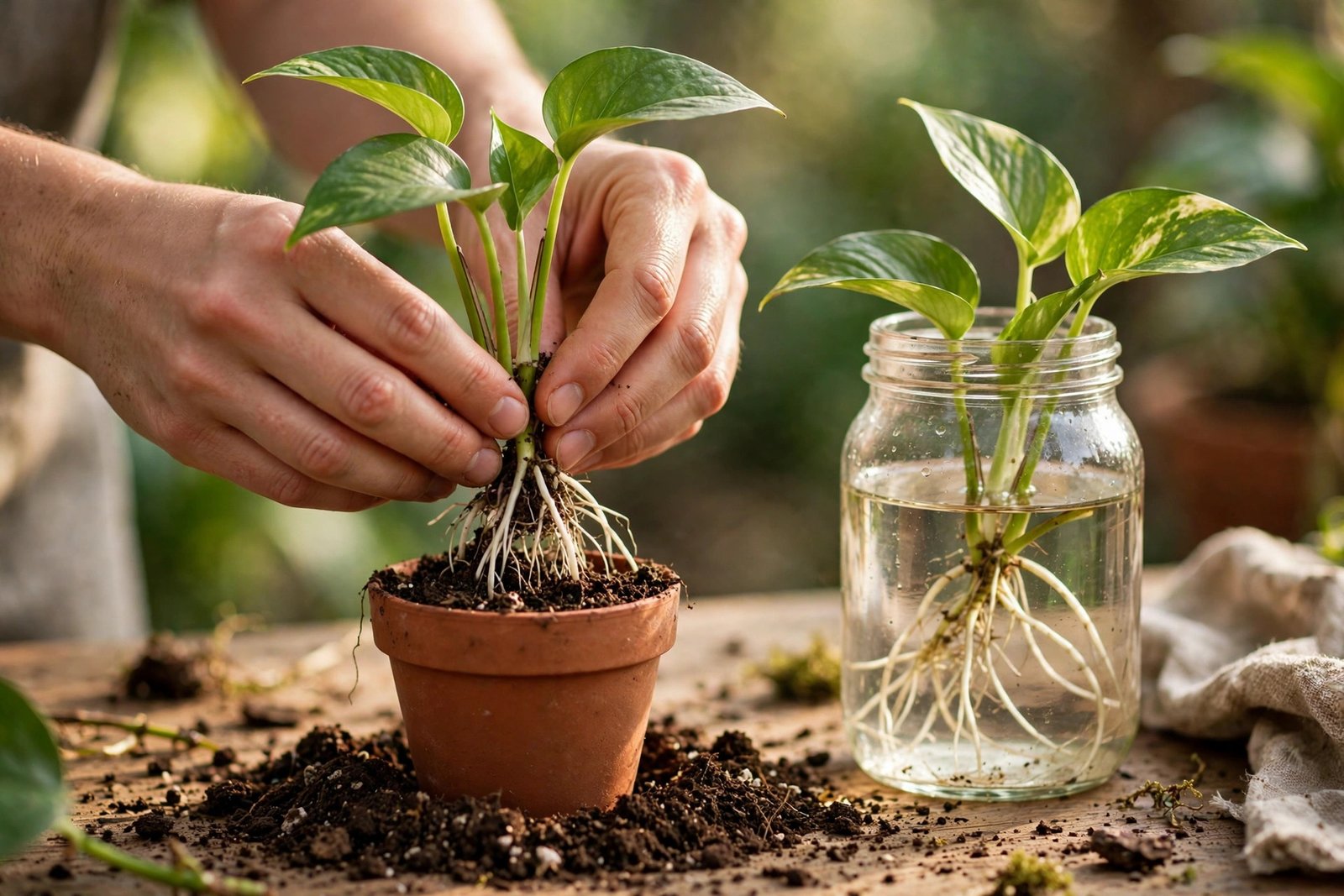
Moving from water to soil (the delicate part)
This transition is where most beginners lose cuttings they successfully rooted. Water-grown roots are fine and delicate, adapted to zero resistance; soil is dense and dry by comparison. The plant needs a gentle handoff:
- Pot small. A 3–4 inch (8–10 cm) pot is plenty for a fresh cutting. Too much soil stays wet and rots the baby roots. Use a light, airy mix — the DIY potting soil recipe works well, or a standard houseplant mix with extra perlite.
- Plant at the right depth. Bury the roots and the node just below the surface, keeping the stem at the same level it sat in water.
- Water thoroughly, then keep the soil consistently moist (not soggy) for the first 2–3 weeks while the roots adapt. This is the opposite of the usual soak-and-dry advice — transitioning roots need steady moisture. The normal routine is explained in the guide to how often to water indoor plants, but for new transplants, keep it damp.
- Humidity helps. A clear plastic bag loosely tented over the pot for the first week reduces transplant shock dramatically. Remove it gradually over a few days rather than all at once.
- No direct sun yet. Bright indirect light until you see new growth — that’s the sign the roots have taken hold.
Expect a sulk. A cutting that looked perky in water may droop for a few days in soil. That’s normal adaptation, not failure. New growth within 2–4 weeks means you’ve done it.
Troubleshooting
The stem went mushy and brown. Classic rot, almost always from stagnant water or a submerged leaf. Fish out the cutting, trim back to firm healthy tissue with clean scissors, and start over with fresh water — changing it on schedule this time. If the rot reached past all the nodes, the cutting is done; take a fresh one.
No roots after a month. Check three things: is there actually a node underwater? Is it warm enough? Is it getting enough light? A pothos cutting in a cold, dark corner in January can sit doing nothing for six weeks, then root in ten days once moved somewhere warmer and brighter.
Algae growing in the jar. Green film on the glass means too much light hitting the water directly. It’s harmless to the plant but unsightly; move the jar slightly back from the window or use an opaque container. A quick scrub of the jar during water changes keeps it clean.
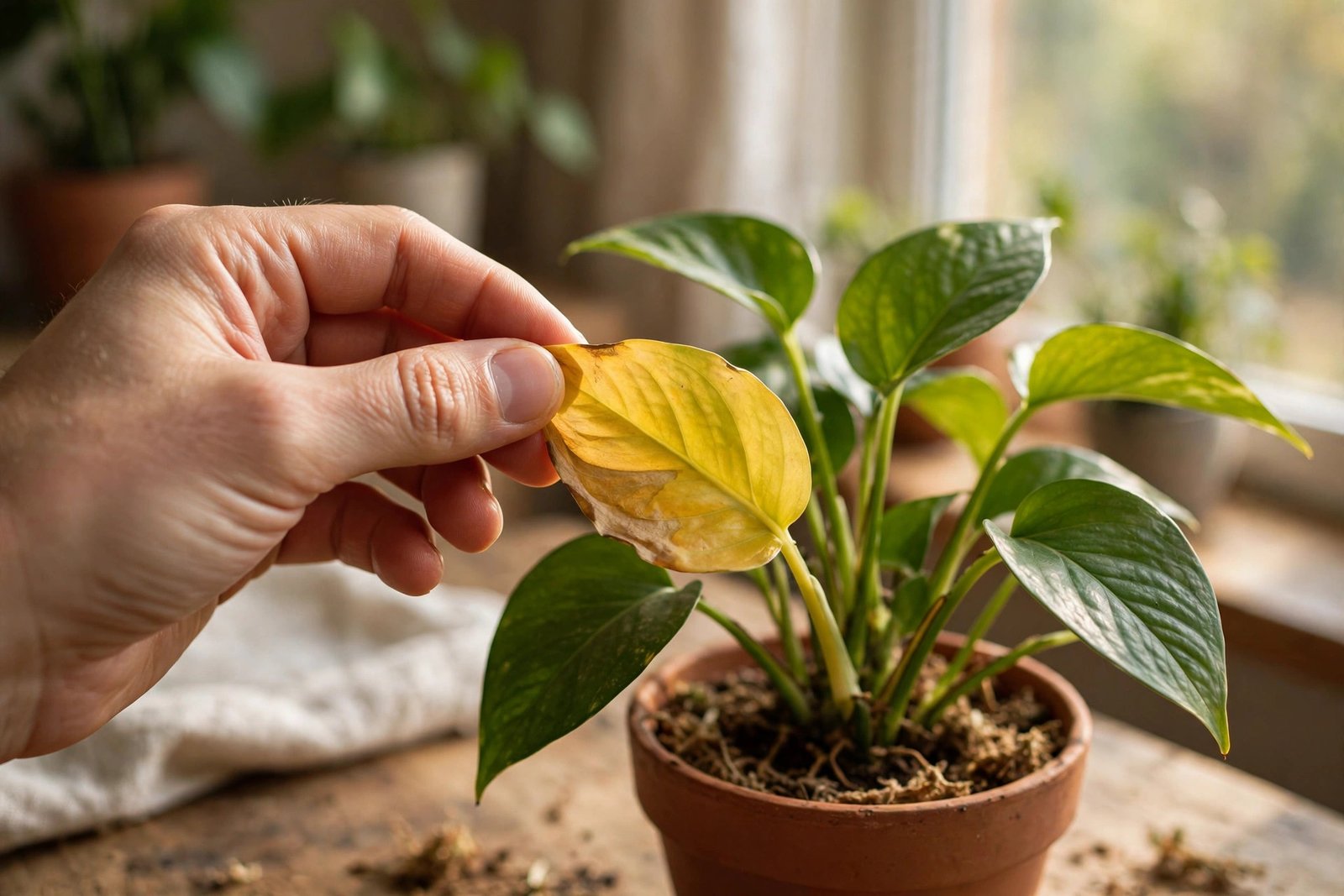
Roots look brown instead of white. Healthy new water roots are white or cream. Brown, slimy roots mean rot is starting — change the water, trim the worst bits, and make sure no leaves are submerged.
The cutting rooted beautifully but died in soil. Almost certainly transplanted too early (roots too short) or the soil was allowed to dry out completely during the transition. Next time: longer roots, smaller pot, consistently moist soil for the first weeks.
Frequently Asked Questions
Can I just leave the cutting in water forever?
For some plants, yes! Pothos, philodendron, lucky bamboo, and arrowhead can live in water for years if you change the water regularly and add a drop of liquid fertilizer monthly (plain water has no nutrients). Growth will be slower than in soil, and you’ll need to top up evaporated water, but a jar of pothos on a shelf is a legitimate long-term houseplant — one can live in the same jar for two years or more.
Do I need rooting hormone?
For water propagation of easy plants, no. Rooting hormone helps with soil propagation of woodier plants, but in water it mostly just dissolves and clouds things up. The plants on the easy list root fine on enthusiasm alone. Save your money.
How long until I have a real plant?
From cutting to established plant in soil: roughly 6–12 weeks for fast rooters like pothos and tradescantia, 3–5 months for slower ones like monstera. It sounds long, but most of that time you’re just changing water weekly and watching roots grow, which is genuinely entertaining. The first time you pot up a cutting you rooted yourself, you’ll understand why people get obsessed.
Why do my cuttings rot every time?
The usual suspects, in order: no water changes (stagnant water breeds bacteria), leaves below the waterline (they rot and contaminate everything), cutting taken from an unhealthy plant, or water that’s too warm and airless. Fix the water-change habit first — it solves the majority of rot cases. Also make sure your scissors are clean; a dirty cut is an infected cut.
Can I propagate from a single leaf?
For most trailing plants, no — you need a stem section with a node. The famous exceptions are succulents (leaf propagation in soil, not water) and snake plants (leaf cuttings in soil or water, very slowly). A pothos leaf without any stem attached will root sometimes but never grow into a plant — it’ll just be a rooted leaf, sitting there, forever. Botanists call these “blind” cuttings. Charming, but not a plant.
That jam-jar pothos is the classic story: one free cutting becomes the grandmother of a dozen plants scattered across friends’ flats. Something that cost nothing and took minutes becomes a whole little lifecycle on a windowsill. Start propagating houseplants in water with a pothos, change the water weekly, and give it time. In a month you’ll be handing jam jars to your own friends, saying “just put it in water” — and meaning it.