
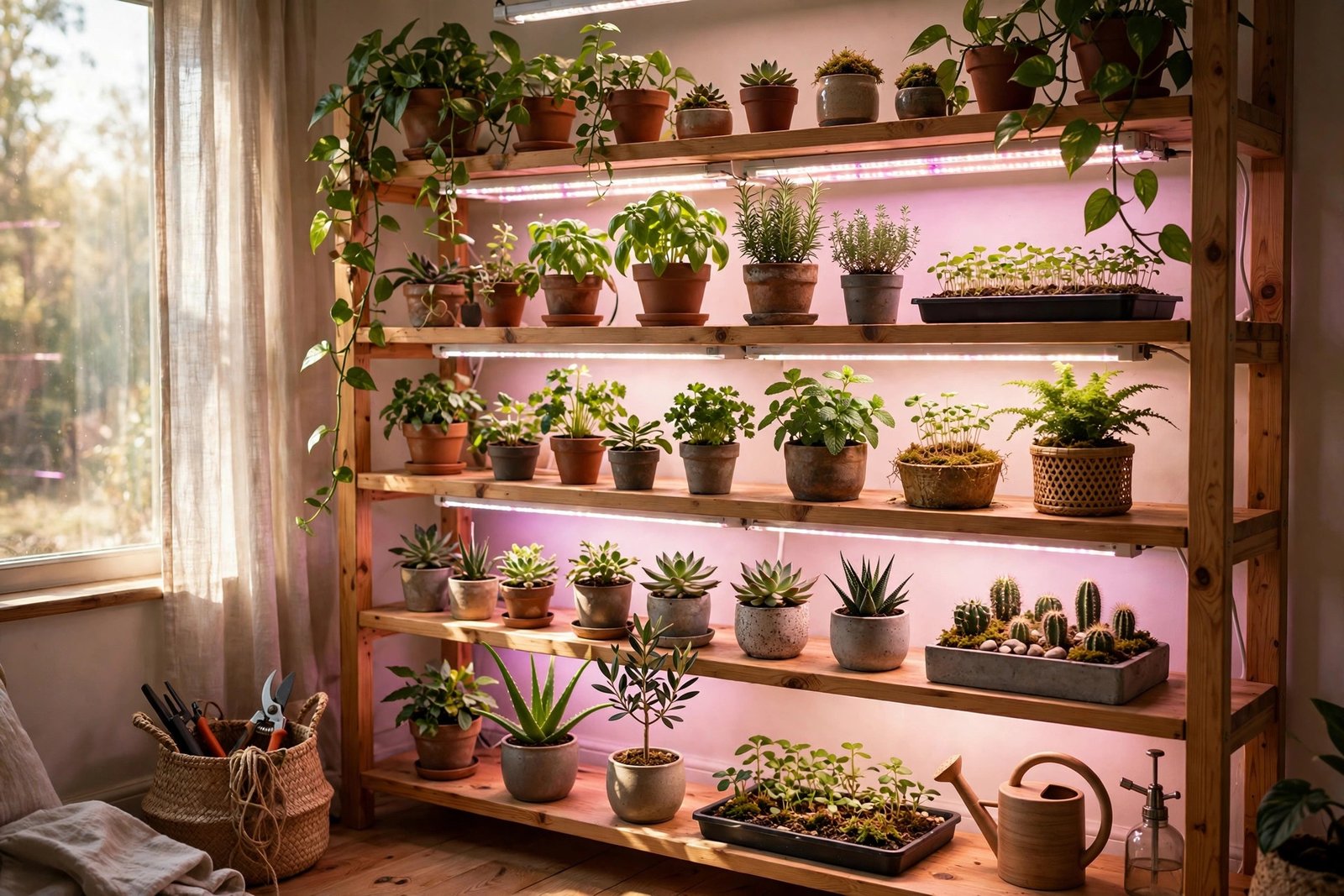
The first grow light many gardeners buy is a cheap purple “blurple” panel from an online marketplace — used wrong for an entire winter. Hung three feet above struggling herbs, on a windowsill that already got decent light, and run for eighteen hours a day like a tiny sun. The basil doesn’t get better. The electricity bill gets worse. And the conclusion is that grow lights are a scam.
They aren’t a scam. That’s just the wrong light, at the wrong distance, for the wrong reason. The part nobody tells you: grow lights aren’t magic, they’re a tool, and whether you actually need one depends entirely on what you’re growing, where, and what time of year it is. Here’s how to skip the blurple era and how these things really work.
What Grow Lights Actually Do
Every plant question comes down to light, water, and soil eventually, but light is the one beginners underestimate most. Outdoors, full sun gives plants roughly 100,000 lux (a measure of brightness). A bright windowsill on a sunny day might give 5,000 to 10,000 lux. Three feet away from that window, in a typical living room, you’re down to maybe 500 lux. A plant that’s going leggy isn’t being dramatic; it’s starving for light in a corner that looks perfectly bright to your human eyes.
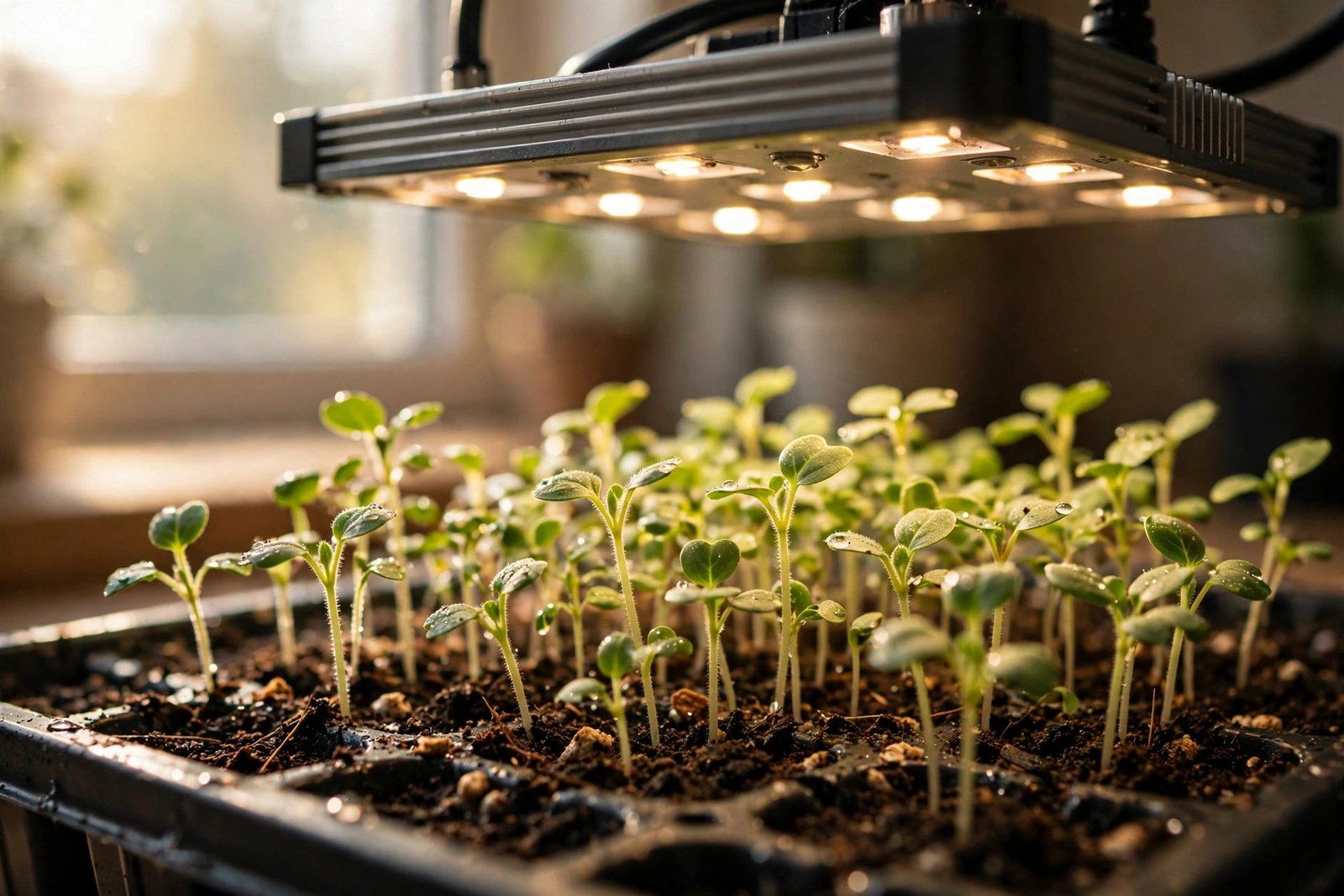
A grow light simply bridges that gap. It gives plants the wavelengths of light they use for photosynthesis — mainly the red and blue parts of the spectrum — at an intensity and duration that compensates for what your window can’t provide. It doesn’t replace good watering habits or decent soil, but for light-hungry plants in dim apartments, it’s often the missing piece.
Quick Tips:
- Most indoor plants need 12 to 16 hours of supplemental light per day in winter; use a timer so you don’t forget.
- Keep LED grow lights 6 to 12 inches (15 to 30 cm) above the plants, not three feet away.
- Full-spectrum white LEDs look like normal light and are far more pleasant to live with than purple “blurple” panels.
- Seedlings are the single biggest reason a small-space gardener needs a grow light; houseplants usually manage without one.
Do You Actually Need One? Honest Scenarios
Let’s get specific, because the answer really is “it depends.”
You probably don’t need a grow light if: your low-light houseplants live in a bright room and look fine, you only garden outdoors on the balcony from spring to autumn, or your windowsill herbs get a solid 5+ hours of direct sun. Plants tell you when they’re coping. Green, compact growth means the light is enough.
You probably do need one if: you start seeds indoors in late winter or early spring (this is the big one — seedlings on a windowsill almost always go weak and leggy), you want to keep herbs productive through the dark months, your apartment faces north or is shaded by another building, or you want to grow anything fruiting — like cherry tomatoes — fully indoors. A south-facing window plus a grow light can keep a ‘Tiny Tim’ tomato ticking over winter; the same window alone won’t.
You’re in the maybe zone if: you’ve got a bright but short winter and just a few plants. Some winters, lights run from November to February and that’s it. Think of it as seasonal support, not a permanent installation.
The Main Types of Grow Lights, Explained Plainly
LED panels and bulbs (the recommendation for most people). Modern full-spectrum LEDs produce white-ish light that covers the whole photosynthetic range. They run cool, sip electricity (typically 10 to 60 watts), and last years. You can get LED bulbs that screw into a standard desk lamp socket — no special fixture needed. This is where you should start.
Fluorescent tubes (T5/T8). The old-school choice for seed starting. Cheap to buy, work fine, but bulkier and they need replacing every couple of years as output fades. If you already own a shop light, it works. Buying a new one today makes little sense when LEDs exist.
CFL grow bulbs. The twisty bulbs. Adequate for one or two small plants, but weak — you’d need them within a few inches of the foliage. Fine as a stopgap, not great as a plan.
The purple “blurple” panels. These were everywhere a few years ago. They combine only red and blue diodes, which is why everything looks magenta. Plants can grow under them, but the light is hideous to live with, makes it impossible to spot yellowing leaves or pests, and modern full-spectrum LEDs outperform them. Skip them.
HID and high-intensity lamps. Overkill for a balcony gardener. Hot, power-hungry, expensive. Designed for serious indoor growing operations. You don’t need this.
What to Look For When Buying
You don’t need to memorise spec sheets, but a few terms help you avoid junk:
- Full spectrum or 5000K–6500K color temperature. This means the light looks like daylight and covers the wavelengths plants use. Aim for this.
- PPFD or PAR rating. If a product lists these, higher is better at a given distance — but most budget listings won’t mention them, which is fine for houseplants and herbs.
- Wattage. For one shelf of seedlings, 20 to 40 watts of LED is plenty. You don’t need a 200-watt panel unless you’re running an indoor jungle.
- Timer built in or separate. Plants need a dark period too — they do a lot of their growing at night. A simple plug-in timer costs very little and saves you remembering to switch the light off. A 14-hour cycle in winter works well.
- Adjustable height or a clamp/stand. The ability to raise the light as plants grow matters more than raw power.
What should you pay? A decent full-spectrum LED bulb is the price of a takeaway coffee or two. A good clamp lamp with a grow bulb runs a bit more. A proper panel for a seed-starting shelf costs roughly what you’d spend on a nice watering can and a bag of potting mix. You do not need to spend serious money here.
Setting Up: Distance, Duration, and the Mistakes I Made
Here’s the setup that actually works, after the blurple fiasco:
Distance matters more than anything. Light intensity drops fast with distance — doubling the distance cuts the light to roughly a quarter. That’s why a light three feet away did nothing. Keep LEDs 6 to 12 inches (15 to 30 cm) above the tops of the plants. For seedlings, start at about 4 to 6 inches and raise the light as they grow. If leaves start looking bleached or scorched, raise it a couple of inches.
Run them 12 to 16 hours a day. In winter, 14 hours, roughly 7am to 9pm, on a timer. In the shoulder seasons, drop to 10 or 12. More than 16 to 18 hours isn’t better — plants need darkness for parts of their metabolism, and an 18-hour experiment just stresses everything and costs money.
Cover the whole plant evenly. A single bulb over the center of a wide shelf leaves the edges dim. For a standard windowsill tray of seedlings, one long tube or two bulbs spaced out beats one bright spot. Watch how the plants respond and shuffle things around — they’ll tell you.
Mind the heat, a little. LEDs run cool, but a light inches from foliage in an enclosed space can still warm things up. Make sure there’s a bit of airflow. In summer you may not need the lights at all, which solves the problem neatly.
Keep your windowsill in the loop. A grow light supplements daylight; it doesn’t have to replace it. A good winter herb setup is a bright windowsill plus one clamp light. Together they’re enough to keep ‘Genovese’ basil, thyme, and parsley growing slowly from December to March, when the window alone would leave them sad and pale.
Which Plants Benefit Most
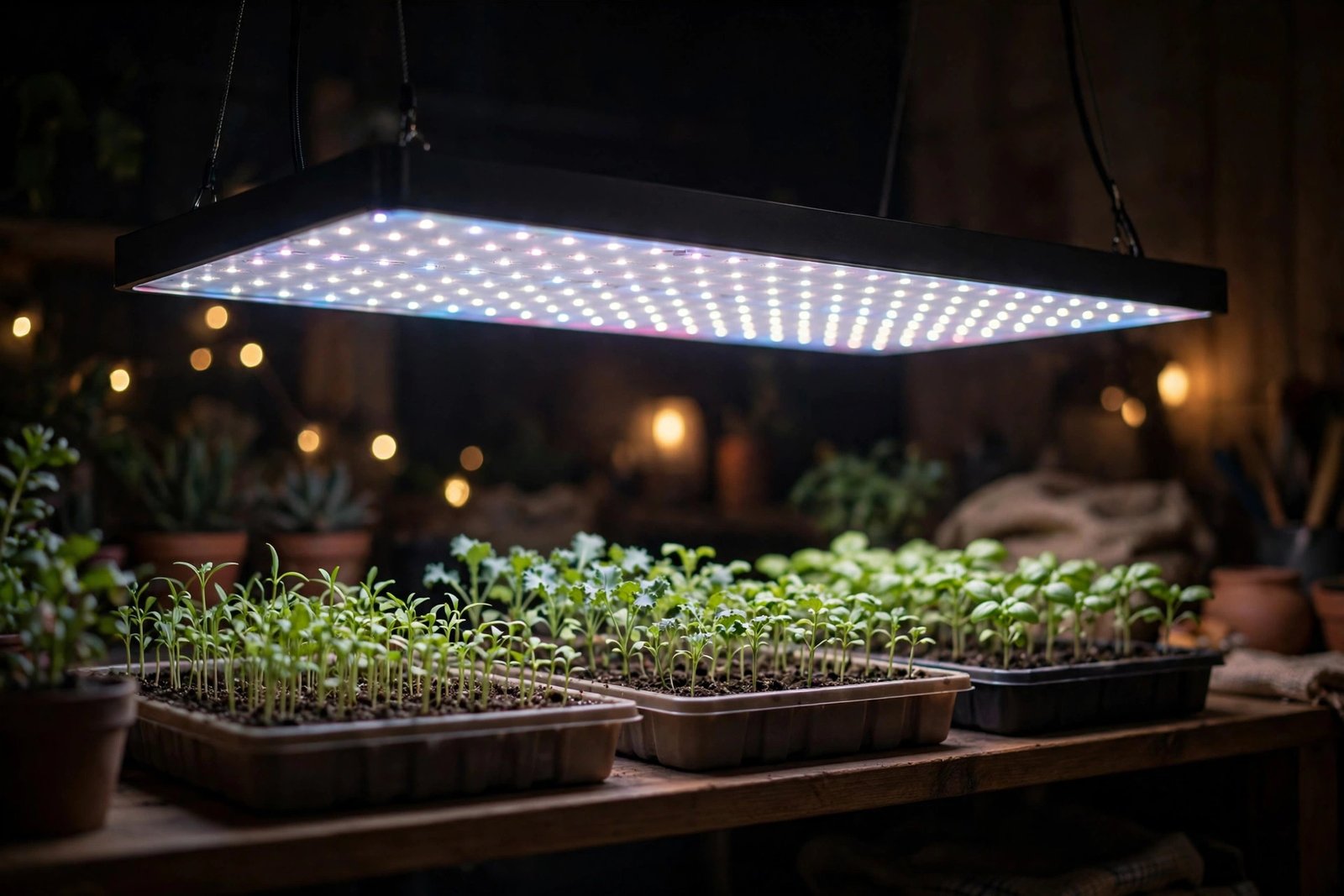
- Seedlings. The number one use case. Sow tomatoes, peppers, or basil indoors 6 to 8 weeks before your last frost, keep a light 4 to 6 inches above them, and you’ll get stocky, strong transplants instead of pale stringy ones. If you only ever use a grow light for one thing, make it this.
- Winter herbs. Basil, in particular, sulks badly in low winter light. A modest light keeps it alive and producing.
- Fruiting plants indoors. Cherry tomatoes, chillies, even a dwarf cucumber like ‘Patio Snacker’ need serious light to set fruit. Possible with lights, but honestly, growing these on the balcony in summer and letting them rest in winter is the simpler path.
- Most decorative houseplants. ZZ plants, pothos, snake plants — they generally do fine without supplemental light. Don’t buy a light to “help” a plant that’s already happy.
The Cost Question
Running a 30-watt LED for 14 hours a day uses about 0.42 kWh daily — over a month that’s roughly 13 kWh, which on typical US or European residential rates adds a couple of dollars or euros to your bill. It’s genuinely cheap to run. The bigger cost is buying the wrong thing first: buy one decent full-spectrum LED setup, put it close to the plants, put it on a timer, and you’re done.
Frequently Asked Questions
Can I just use a normal desk lamp or LED bulb?
A regular bright white LED bulb (5000K–6500K, often labelled “daylight”) genuinely works for undemanding plants — one over a pothos does fine for a whole winter. Dedicated grow bulbs are tuned better for plants and usually worth the small premium, but a daylight desk lamp a few inches from a houseplant is far better than nothing.
Will a grow light burn my plants?
LEDs rarely burn plants from heat, but too much light intensity can bleach leaves — they’ll look washed out or develop pale patches. If that happens, just raise the light a few inches. It’s an easy fix and the plant recovers.
Do plants need the light on 24 hours?
No — please don’t do this. Plants need a dark period of at least 6 to 8 hours for healthy growth. 12 to 16 hours of light is the sweet spot. A timer handles it so you never have to think about it.
Can grow lights replace sunlight completely?
For houseplants and leafy herbs, yes, more or less — plenty of people grow entirely under lights. For fruiting plants like tomatoes, it’s possible but needs strong lights and gets expensive. For a balcony gardener, think of lights as a winter supplement, not a replacement for the sun.
Are those purple lights bad for your eyes?
They’re unpleasant rather than dangerous at household intensities, but staring into any bright light isn’t great, and the purple glow makes it hard to check your plants’ health. That’s one more reason to choose full-spectrum white LEDs — your living room stays looking like a living room.
So, do indoor gardeners really need grow lights? If you’re starting seeds or nursing herbs through a dark winter in a shaded flat — yes, and you’ll wonder how you managed without one. If your plants are thriving on the windowsill already, save your money. Buy the light when the plants tell you they need it, put it close, put it on a timer, and skip the blurple phase. Your basil will thank you.

3 Comments on “Grow Lights Explained: Do Indoor Gardeners Really Need Them?”