When did you last actually check what the soil is doing down where the roots are? Not the top centimetre — that tells you almost nothing — but three inches down, where your plant is either thriving or quietly drowning. My answer, for my first two years of gardening: never. I watered by schedule, by vibes, by how dry the surface looked, and I killed an embarrassing number of houseplants before admitting I had no idea when anything actually needed water.
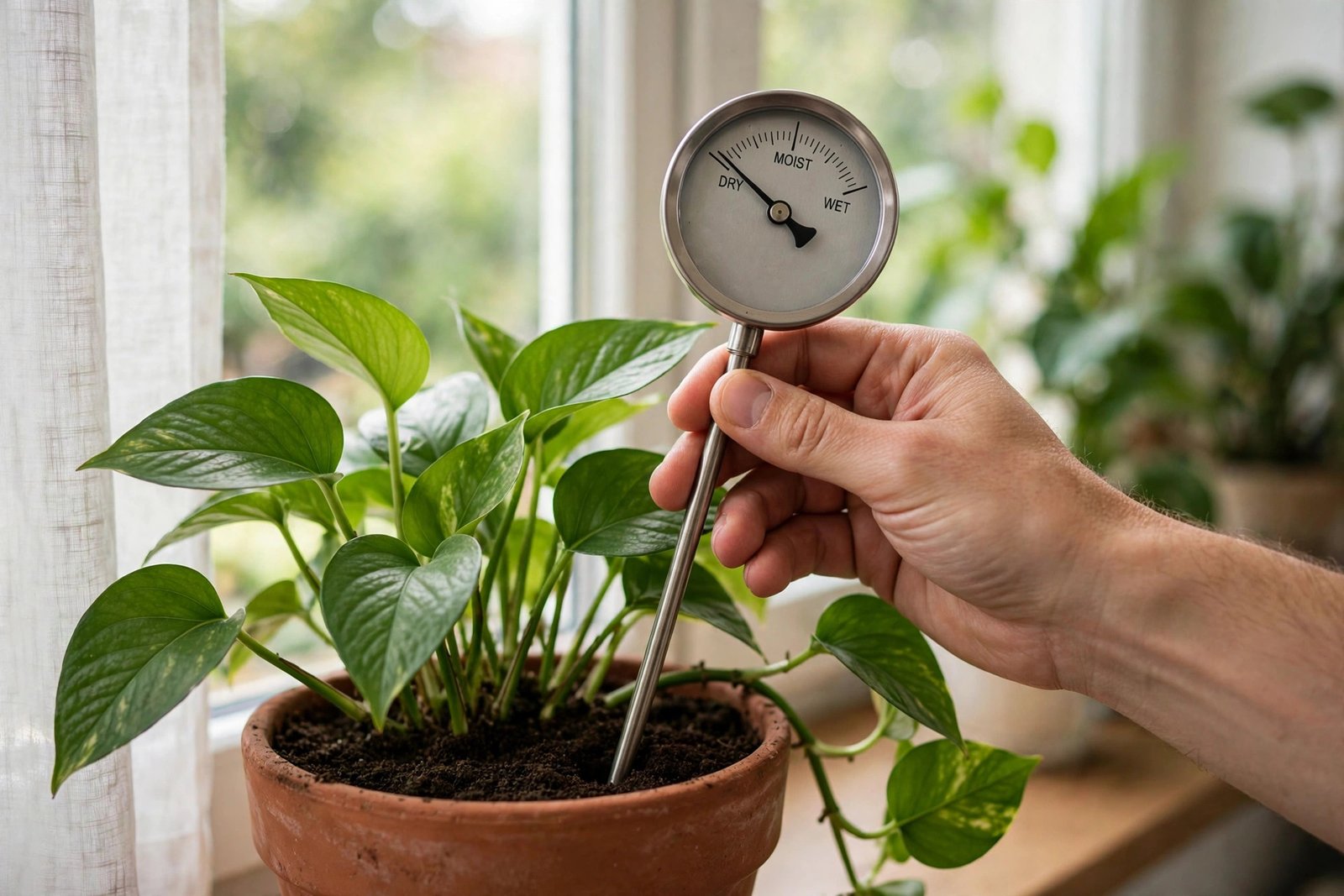
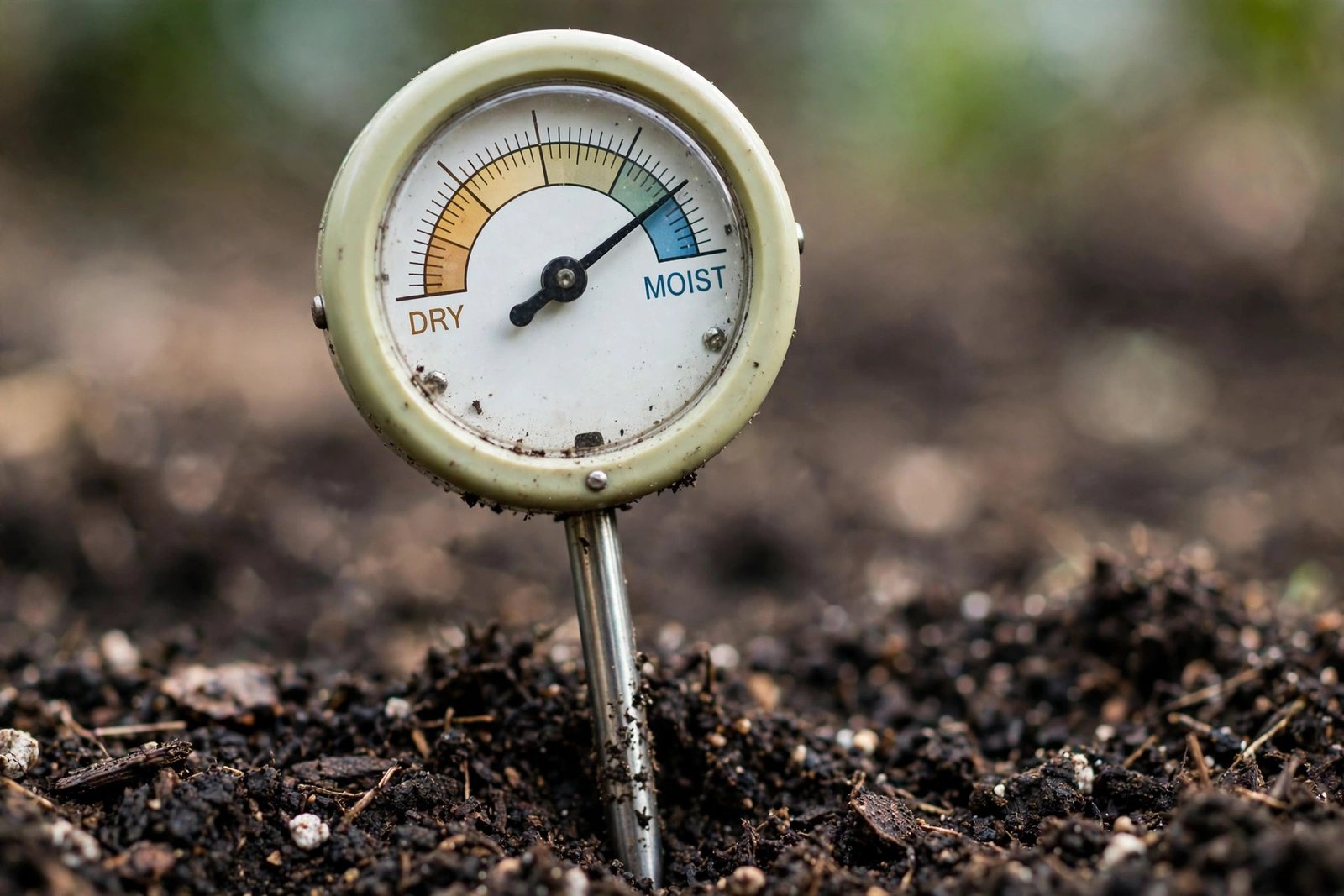
The thing that ended my overwatering habit cost less than a sandwich: a little metal probe with a dial on top that tells you in ten seconds whether the root zone is dry, moist, or wet. It isn’t fancy. It isn’t digital. And it has saved more of my plants than every gardening book I own.
Quick Tips:
- Push the probe into the soil to root depth (about halfway down the pot) and wait 30–60 seconds before reading the dial.
- Water most houseplants when the meter reads 2–3 (dry); succulents and cacti can wait until 1.
- Always test in two or three spots per pot — moisture is rarely even.
- Wipe the probe clean after every use so it doesn’t corrode and give false readings.
- For pots wider than 10 inches (25 cm), test near the plant stem, not the pot edge.
Why I Bought One (The Great Pothos Incident)
In 2020 I had a golden pothos grown from a friend’s cutting — my pride, trailing three feet down the bookshelf. Then leaves started yellowing, and my response was to water more, because yellow obviously means thirsty, right? A month later I pulled it out: brown mush for roots. I’d watered a drowning plant for weeks while telling myself I was helping.
That pothos died because the surface dried out between waterings — so it looked thirsty — while the bottom of the pot stayed soggy the whole time. A finger test would have helped, but I never liked getting soil under my nails, so I kept “forgetting” to do it. The meter was my compromise: no dirty fingers, no guessing, just a number. The replacement pothos is four years old and enormous.
Overwatering is the number one houseplant killer — I’d bet on it against every other cause combined. The guide to overwatering versus underwatering goes deeper on how to spot the difference, but here’s the short version: underwatered plants bounce back within hours of a good drink. Overwatered plants rot quietly and often don’t tell you until it’s too late. A meter tilts the odds in your favour because it removes the guesswork that kills.
How a Moisture Meter Actually Works
The cheap analog meters most beginners buy — the kind with a dial reading 1 to 10, usually under £10 / $12 — measure electrical conductivity in the soil. Wet soil conducts electricity better than dry soil, so the needle moves. No batteries, no charging, no app. You push the probe in, wait a minute, read the dial: 1–3 is dry, 4–7 is moist, 8–10 is wet.
They’re not laboratory instruments — I want to be honest about that. They won’t give you a precise percentage, and readings drift a bit between brands and soil types. But they don’t need to be precise: the question isn’t “what is the exact water content?” but “should I water today or leave it alone?” For that, a rough reading beats the surface-glance method by miles.
Choosing One: What to Buy (and What to Skip)
For a beginner, the basic single-probe analog meter is the right buy. Look for a probe at least 7–8 inches (18–20 cm) long — shorter probes can’t reach the root zone of bigger pots, which defeats the purpose. A sturdy metal probe beats a flimsy one; the cheapest models bend if you force them into compacted soil, so ease it in rather than ramming it.
There are fancier options: digital meters, three-in-one meters that also measure pH and light. The three-in-one light readings are unreliable in my experience — I tested one against a proper light meter and it might as well have been guessing. Keep it simple: one probe, one dial, under fifteen pounds or dollars, and spend the savings on an actual plant.
How to Use It Properly
Using a moisture meter is almost embarrassingly simple, but there are a few details that separate a useful reading from a misleading one.
Go deep. Push the probe to about two-thirds of the pot’s depth — that’s where the roots drink. A reading from the top inch is just an expensive version of looking at the surface.
Wait. Give it 30–60 seconds to settle. The needle creeps up slowly; reading it the second you push it in will always show drier than reality. I use the wait to check the plant’s leaves — it’s become a little ritual.
Test more than one spot. Water doesn’t spread evenly through compost. I once had a monstera reading 7 (moist) on one side and 2 (dry) on the other, because I always watered from the same side. Two or three pokes per pot, varying the position so you don’t compact one channel.
Know your plant’s number. This is the part people skip, and it’s the most important. A fern and a cactus don’t want the same reading. My rough guide, tested on my own windowsills:
- 1–2 (dry): water succulents, cacti, snake plants, and ZZ plants now — and only now. These are the ones that rot if watered sooner.
- 2–3 (dry-ish): the watering point for most houseplants — pothos, philodendron, monstera, spider plants, peace lilies. When the meter drops to 2–3, water deeply.
- 4–5 (moist): walk away. Calatheas, ferns, and other moisture-lovers are happy here; watering now just keeps things soggy.
- 8–10 (wet) for days on end: you’ve got a drainage problem. Check the holes aren’t blocked and the plant isn’t sitting in a full saucer.
Reading the Results: What the Dial Is Telling You
The dial is only half the story — the other half is the pattern over time. My snake plant takes three weeks to drop from 5 to 2 in winter; my peace lily does it in four days in summer. Once you know each pot’s rhythm you barely need the meter — but I still check, because plants change with the seasons and I’m not as good at noticing as I think.
Watch for readings that don’t make sense. A meter reading 9 (wet) a week after watering in a pot with drainage holes probably means the probe is sitting in compacted, airless compost — or drainage is blocked. A meter swinging from 2 to 9 and back within a day is telling you the compost has gone hydrophobic: water is channelling down the sides instead of soaking in. Fix it by bottom-watering — stand the pot in a few inches of water for 20–30 minutes.
And a mistake I made for months: leaving the probe in the pot permanently. The metal corrodes, readings drift, and you end up trusting a lying meter. Poke, read, wipe, store. Thirty seconds of care keeps it accurate for years — mine is on year four.
Where the Meter Fits in Your Watering Routine
A moisture meter doesn’t replace the rest of good watering habits — it upgrades them. I still water in the morning, deeply, until it runs from the drainage holes, and still empty saucers after half an hour. The meter just answers the one question I used to get wrong: today, or not today? If you’re still working out rhythms, how often to water indoor plants gives you the starting points, and the meter adjusts them to your actual home.
It’s also brilliant for the plants you’re scared of — the expensive calathea, the gifted orchid. The meter takes the fear out because you’re deciding based on a number, not anxiety. My calathea and I have an understanding now: it drops to 3, it gets watered, and it hasn’t crisped a leaf edge in over a year.
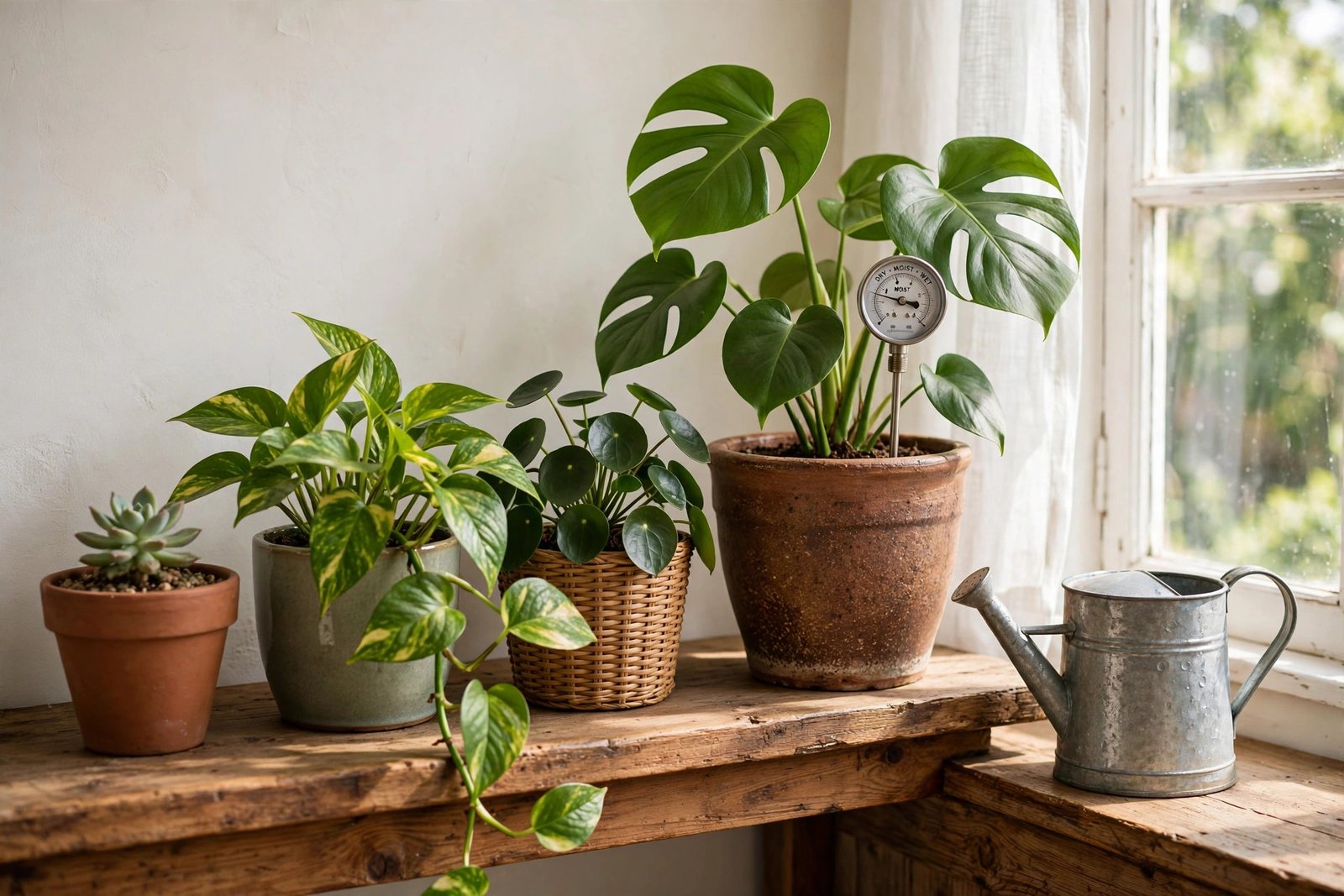
For balcony pots in summer, the meter stops you underwatering instead: in a heatwave, a big tomato pot can look fine on top and be bone-dry at the roots by evening. A quick poke at 7pm tells you whether the morning’s water lasted. And if you’re weighing up watering systems, the comparison of watering cans versus self-watering pots pairs well with a meter: the pots handle supply, the meter tells you when to refill.
The Limits: What a Meter Can’t Do
Fair warning: a moisture meter won’t fix bad drainage, wrong-sized pots, or compost that’s turned to dust. If every reading says wet and the plant is still dying, the problem is the pot, not your watering — repot it. It also can’t tell you about light, humidity, or pests, which cause their fair share of yellow leaves.
And don’t become a slave to the dial. I went through a phase of checking daily and adjusting by single points, which is just anxiety with extra steps. Check weekly for most plants, more often in heatwaves, and trust the pattern rather than obsessing over a 3 versus a 4. The meter’s real job is just to stop you loving plants to death with the watering can.
Your Questions, Answered
Are cheap moisture meters accurate enough to trust?
For the job a beginner needs — dry, moist, or wet at root depth — yes. They’re not lab-grade, and two meters in the same pot might read a point apart, but the gap between “water now” and “leave it alone” is wide enough that a rough reading is plenty. I’ve never needed a digital one in six years.
Can I leave the probe in the soil all the time?
I wouldn’t. Constant contact with damp soil corrodes the probe, readings drift, and you end up watering on bad data. Poke, wait a minute, read, wipe clean, put it away — that routine keeps it accurate for years.
How deep should I push the probe?
About two-thirds of the way down the pot, where most active roots are. For a standard 6-inch (15 cm) pot, that’s nearly the full length of a normal probe. In very large pots (12 inches / 30 cm and up), take readings at two depths if your probe reaches — the bottom can stay wet long after the middle has dried.
My meter always reads wet. Is it broken?
Probably not — it’s likely telling you something true and uncomfortable. Constant “wet” usually means poor drainage: blocked holes, no holes, the plant sitting in a full saucer, or compost compacted into sludge. Check the pot first. If the pot’s fine and the reading never moves, test the meter in a glass of water (should read high) and dry compost (should read low).
Do I still need the finger test if I have a meter?
Honestly, the meter is a better finger test — same principle, deeper reach, no dirty nails. I still poke the soil out of habit, but the meter does the real work. Fingers for a quick daily glance, the meter for the actual decision.
Will a moisture meter work in gritty cactus soil or leca?
In very gritty cactus mixes the readings run lower and less reliably, but “reads dry” is still useful information for a cactus. In leca or pure hydro setups, standard meters don’t work properly — those need their own approach. For normal compost, which is what most houseplants sit in, they work exactly as advertised.
If you take one thing from this, let it be the pothos lesson: the surface lies. Ten seconds with a probe tells you what your eyes can’t, and that one habit — check before you water — will save more plants than any fertiliser or app. Mine lives in the watering can, so I can’t water without tripping over it. Four years, one dead pothos behind me, zero since. Get the meter.