For the first two years I lived in my apartment, the view from my balcony included one very unwelcome regular: the neighbour across the courtyard, doing her dishes at the kitchen sink, watching me eat my breakfast. Her window and my chair were maybe twenty feet apart, perfectly level, and there was nothing between us but air and mutual embarrassment. I waved. She waved. I started eating breakfast indoors.
My first attempt was pure optimism: six small lavender plants along the railing. They were pretty, they smelled lovely, and at eight inches tall they screened my ankles. My second attempt was a bamboo roll-up blind, which lasted one windy night before landing in the courtyard below. That was when I started treating balcony privacy plants as an actual problem: what grows tall enough, fast enough, in a pot, in wind, on a rented balcony where I can’t drill anything?
Three years later I’ve got a green wall that genuinely works. This is what I’d tell you over the fence, if we had a fence.
What a Balcony Screen Actually Has to Do
Before picking a single plant, know what you’re asking of it: in a pot, root space, water, and nutrients are all limited, and your balcony adds wind plus landlord rules about what you can attach to the building. A good balcony privacy plant has to grow at least 4–5 feet above the railing, do it in a container, survive the wind, and look decent most of the year — privacy you only get in August isn’t privacy. The plants below passed that test on my balcony. The lavender did not.
My Screening Strategy: Layer, Don’t Just Line Up
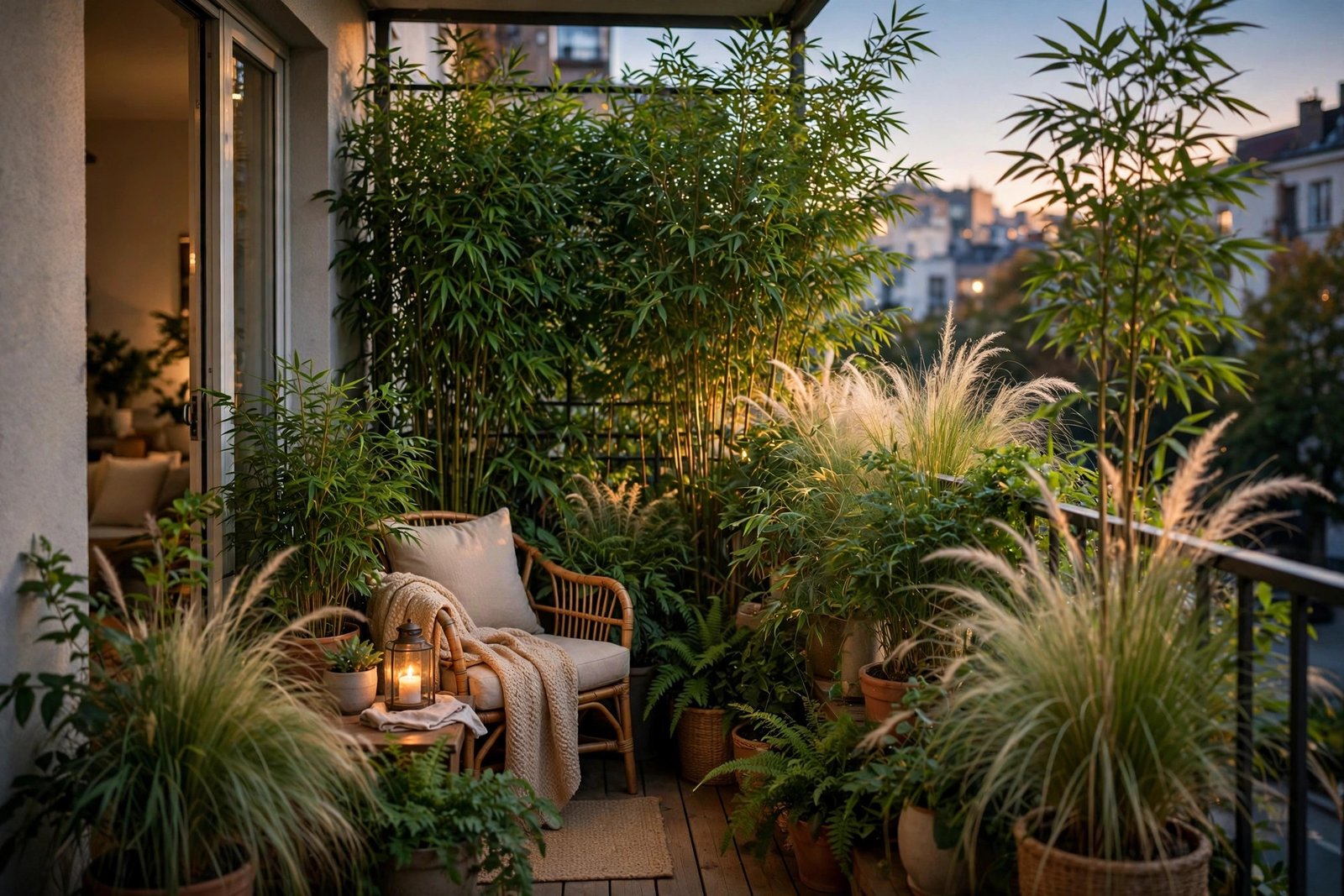
The mistake most people make (me included, first year) is lining up identical plants and expecting a wall. What works is layers: tall background plants along the railing, medium fillers in front, trailers at the edge. Gaps are the enemy — a row of single plants always has see-through slits between pots — and layering closes them.
My own corner now has tall grasses along the railing where her window is, jasmine on a trellis at the end, and lavender and geraniums in front. From her sink: green. From my chair: green. Breakfast feels private again, which is the whole point.
Tall Ornamental Grasses: My Top Pick
If I could only recommend one category of balcony privacy plants, it would be tall grasses. They grow fast (full height in one season), they’re inexpensive, they move in the wind instead of fighting it, and they look good from March to November.
Miscanthus sinensis (maiden grass) is my workhorse. The variety ‘Gracillimus’ grows 5–6 feet tall in a 16–20 inch (40–50 cm) pot, with fine arching leaves and feathery late-summer seed heads. It’s hardy, needs almost nothing beyond a cut-down in late winter, and the dense foliage genuinely blocks a view.
Pennisetum ‘Rubrum’ (purple fountain grass) is the prettier, less hardy option — deep burgundy foliage, 3–4 feet tall. I treat it as an annual: a fresh plant each spring for the price of a pizza, screening from June until the first hard frost.
Calamagrostis ‘Karl Foerster’ (feather reed grass) is the upright, tidy one — strict vertical stems to about 5 feet, never floppy, and it stays standing through winter, which means your privacy screen doesn’t collapse in January. I keep one at the end of my balcony where the wind is strongest, and it has never complained.
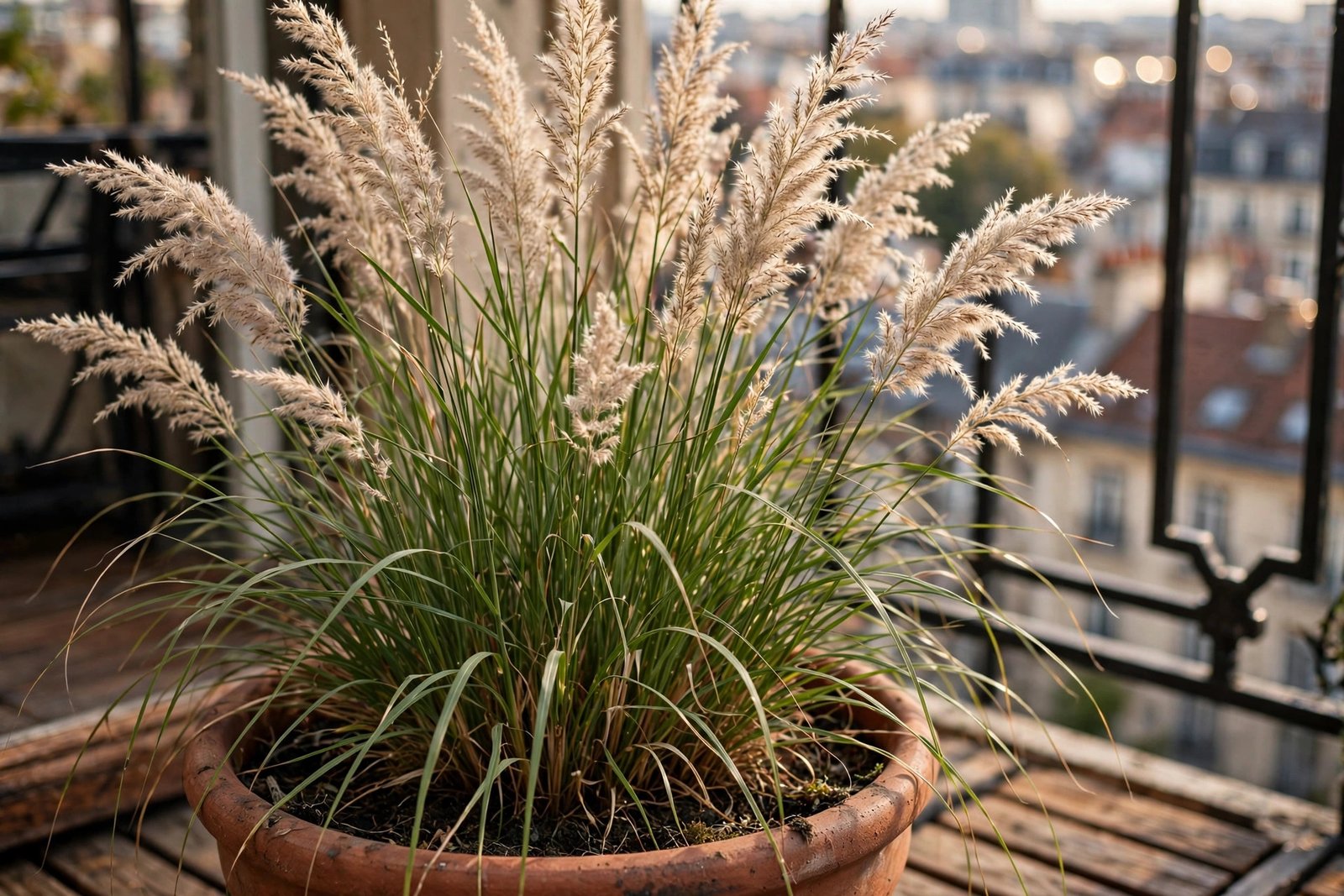
Pot tips for grasses: go big — a 16–20 inch (40–50 cm) pot with a 50/50 mix of multipurpose and loam-based compost, mulched on top. Tall grasses are the thirstiest plants I own: daily watering in summer, sometimes twice in a heatwave. Self-watering planters changed my grass-watering life.
Bamboo in Pots: The Fast Green Wall
Nothing gives instant privacy like bamboo — it’s the only plant I know that can turn a bare balcony into a green screen in a single afternoon. Buy tall plants (5–6 foot canes in 5-litre pots), line them up, and you’re done by dinner. It feels like cheating, and I’m fine with that.
But — saving you from my own nearly-disastrous first year — only plant clumping bamboo in pots. Running bamboo will escape, crack the pot, and march across your balcony. Clumping types like Fargesia ‘Murielae’ or ‘Rufa’ stay tidy, reach 5–7 feet in a big pot, and are evergreen — so your screen works in February too.
Bamboo wants a generous pot (18–24 inches / 45–60 cm), moisture-retentive compost, and feeding from April to August — slow-release fertiliser in spring plus a liquid feed every two weeks. Never let it dry out: a thirsty bamboo drops its leaves, the opposite of privacy. Weight the pots with bricks at the base so wind can’t topple them.
Trellis Climbers: Privacy That Grows Upward
If floor space is tight, grow up instead of out. A trellis panel cable-tied to the railing (no marks for the landlord) with a climber at its base gives you a living wall in two feet of depth. The vertical gardening ideas for tiny balconies pair perfectly with this.
Trachelospermum jasminoides (star jasmine) is my favourite climber for this. Evergreen, glossy leaves, and in June the scent drifts across the whole balcony. It’s slow the first year, then takes off — give it a 14–16 inch (35–40 cm) pot and something sturdy to grip. Below USDA zone 7, grow it in a pot you can move inside for winter, or use hardier honeysuckle ‘Serotina’ instead.
For faster results, annual climbers can’t be beaten: sweet peas and morning glory cover a 6-foot trellis from a spring sowing by July. They die in autumn, but a packet of seeds in April means privacy plus flowers by midsummer — I’ve made it a yearly ritual. Pair a fast annual with a slow perennial on the same trellis: instant cover now, permanent screen later.

Clematis works too — viticella ‘Etoile Violette’ flowers for months — but shade its pot, since clematis likes cool roots. And avoid ivy on a rented balcony: it glues itself to the building, and your deposit won’t survive it.
Quick Tips:
- Layer your plants: tall grasses or bamboo at the back, medium fillers in front, trailers at the edge — layering closes the gaps a straight row leaves open.
- Use pots at least 16 inches (40 cm) wide for anything over 4 feet tall, or you’ll be watering constantly and the pots will blow over.
- Only plant clumping bamboo (Fargesia) in containers — running bamboo will escape and destroy pots.
- Fix trellis panels with cable ties, not screws, if you rent — sturdy, invisible, and landlord-proof.
- Weigh tall pots with bricks or stones at the base so wind can’t topple your entire screen.
What to Avoid: My Failed Experiments
Honesty demands the misses. The lavender screen was too short — check the mature height, not the nursery-pot height. The bamboo blind blew away — fabric on a windy balcony needs bombproof fixing, and plants beat hardware. Tall sunflowers screened beautifully for six weeks in August, then became brown sticks: annuals are great filler, terrible main strategy.
Also mind the weight: a row of 24-inch terracotta pots full of wet compost is genuinely heavy, and balconies have limits. Check your lease — most handle large plastic or resin pots fine, but skip the concrete planters. When in doubt, lighter pots, not fewer plants.
The Wind Problem (and How I Solved It)
Everything about balcony privacy gets harder in wind, and my fifth-floor balcony has cost me a chair. Tall plants become sails, so shelter your screen plants with your screen plants: the sturdiest grasses at the windward end, delicate climbers behind them, pots grouped so they brace each other. Porous screening (plants, canes) beats solid screening (tarps, panels) because it lets wind through instead of catching it.
Water is the other wind tax: on a breezy July day my big grass pots need water every morning. Mulch every surface, use saucers, and consider self-watering planters for the thirstiest pots — they’ve halved my watering.
Making It Cosy, Not Just Private
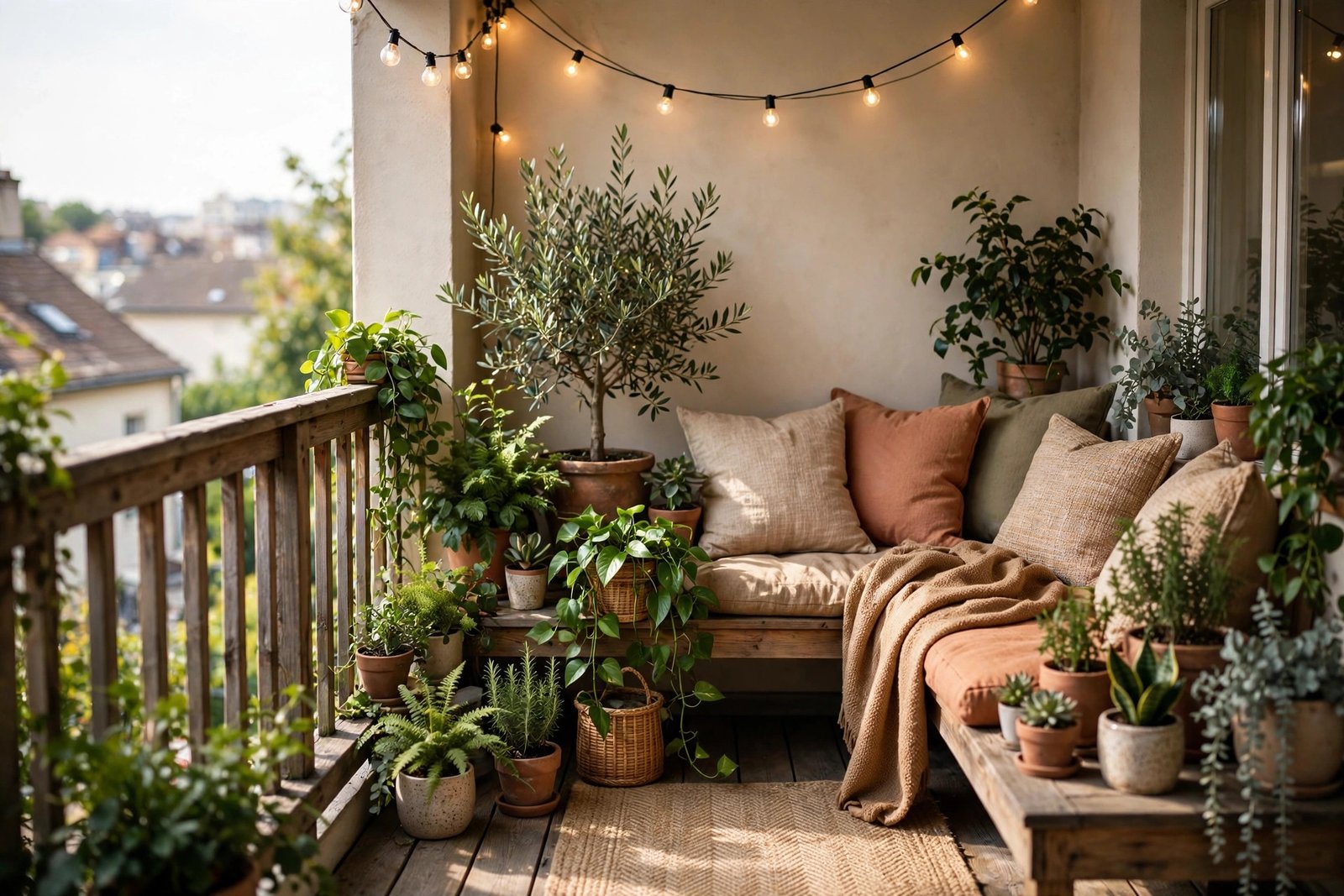
A screen is half the job — the other half is making the space behind it somewhere you want to sit. I added a second-hand chair, warm solar lights along the railing, and low pots of herbs in front of the grasses: under fifty pounds total, and that corner now gets used more than my living room. For the full walkthrough, see the cosy balcony garden corner on a budget guide, and hanging plants for small balconies for bare vertical space.
Frequently Asked Questions
How tall do balcony privacy plants need to be?
It depends on where the sightlines come from. If the overlooking window is level with your balcony and twenty feet away, plants 4–5 feet above your railing usually do the job — you’re breaking the direct line of sight, not building a fortress. If the neighbour is above you, add height plus hanging baskets at head height. Sit in your chair, have a friend stand where the neighbour stands, and check — that’s the only test that matters.
Will bamboo in a pot damage my balcony?
Clumping bamboo (Fargesia) in a pot won’t damage anything — it stays contained. The danger is only with running bamboo planted into beds or decking, where it lifts paving and creeps. Repot or root-prune every 2–3 years when it gets congested, and you’re fine.
What’s the cheapest way to get privacy on a balcony?
Annual climbers on a cheap trellis: a packet of morning glory or sweet pea seeds, a £10 trellis panel, and a big pot of compost. By midsummer you’ve got six feet of flowers for less than a takeaway. It won’t last through winter, but for a first season it’s unbeatable value while permanent plants establish.
Do privacy plants survive winter on a balcony?
The evergreen ones do: clumping bamboo, star jasmine, and Calamagrostis ‘Karl Foerster’ (which holds its stems all winter) all keep screening through the cold. Miscanthus dies back, but the dried stems still give partial cover until the spring cut-down. Tender plants like purple fountain grass need replacing each spring — budget for them as seasonal colour, not infrastructure.
How do I stop tall pots from blowing over?
Three things: wide, heavy pots (at least 16 inches / 40 cm — avoid tall narrow ones), weight in the base (bricks or stones under the compost), and grouping pots so they shelter each other. In exposed spots, run garden twine from the pot rim to the railing as a discreet anchor — invisible from three feet away, and nothing has toppled since.
My balcony went from fishbowl to green room in one season, and it changed how much I use the space — breakfast is back outside, and the neighbour and I still wave, but now it’s optional. Start with one corner: a couple of big grasses, one trellis, and a chair. You can always add more green once you see how good the first bit feels.